
Search almost any serious discussion of Empowerment of Women and poverty reduction and you will find the same conclusion repeated in different language: when women gain access to paid work, education, and legal rights, poverty declines faster and more sustainably. Household health improves, children stay in school longer, and communities become more resilient to economic shocks.
What is often overlooked is that this is not a modern discovery. Long before development economics existed, history was already demonstrating the effect—sometimes unintentionally, sometimes at enormous human cost. One of the clearest examples occurred in Britain during the First World War, and it sits at the heart of my novel A Penny a Shell.
Key Takeaways
- Empowerment of Women increases household spending on health, nutrition, and education, directly reducing intergenerational poverty.
- Access to paid work and education raises lifetime earnings and strengthens economic resilience at both household and national levels.
- Historical crises show women rapidly acquire skills and sustain complex production when given opportunity.
- Gains are fragile: without legal, social, and policy support, women’s economic advances are often reversed.
- Remembering women’s labour is essential to preventing its future erasure.
Why Girls and Empowerment of Women Is the Fastest Way Out of Poverty
Across societies and eras, women tend to reinvest income into family wellbeing—food, healthcare, education—creating a stabilising effect that benefits the next generation. This is why strengthening women consistently produces broader poverty reduction than growth strategies that ignore gender.
Education raises women’s lifetime earnings and health outcomes. Paid work increases household security. Legal rights and decision-making power determine whether those gains last. Where unpaid care burdens remain unaddressed, women’s participation is constrained; where childcare, schooling, and legal reform accompany employment, progress accelerates.
This is not ideological. It is practical, observable, and historically repeatable.

When Women Worked, Britain Survived
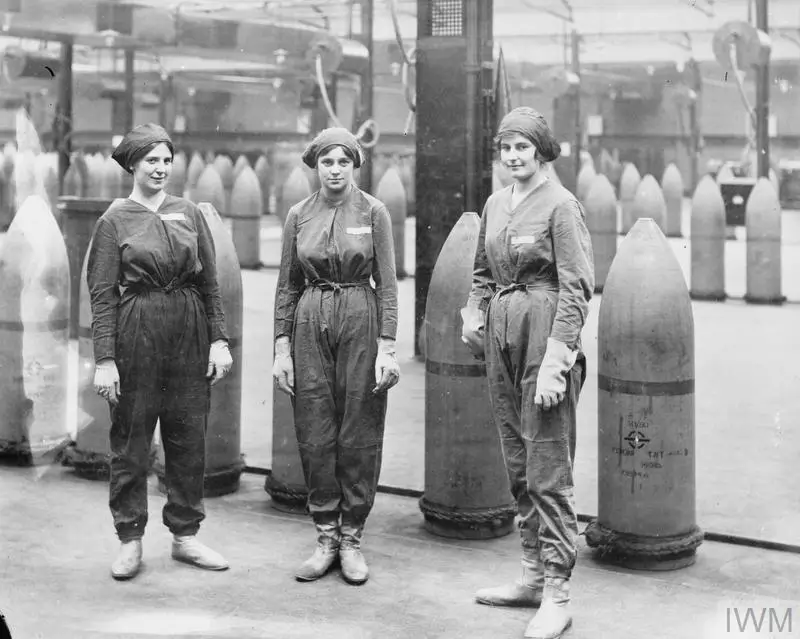
By 1915, Britain faced an existential labour crisis. Millions of men were overseas, yet industrial production—especially munitions—had to increase dramatically. The solution was not symbolic inclusion but necessity: women entered factories, farms, transport, and offices in unprecedented numbers.
Their wages stabilised households that might otherwise have fallen into poverty. Their labour sustained industrial output and civilian morale. For the first time, many working-class women experienced financial independence and mobility.
This shift challenged pre-war assumptions about capability and gender roles, not through argument, but through performance. Britain survived because women worked.
Barnbow and the Reality of Female Industrial Power
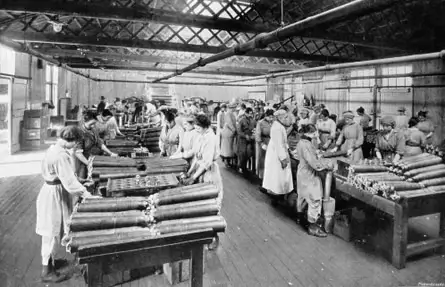
At the Barnbow munitions factory near Leeds, thousands of women worked long night shifts filling shells with high explosives. The work was dangerous, exhausting, and highly skilled. Output targets were relentless. Mistakes could be fatal.
Historical records show rapid skill acquisition and disciplined production that made Barnbow one of Britain’s most productive shell-filling sites. Employment brought wages into homes that had previously known chronic insecurity. It altered household economics and reshaped local labour markets.
In A Penny a Shell, these women are not treated as symbols of progress. They are workers—tired, anxious, proud, and motivated by the same concerns that drive poverty reduction everywhere: food on the table, rent paid, children protected.
Then, in December 1916, an explosion killed 35 women.
What followed matters just as much.
Progress That Was Convenient — and Then Taken Back
The deaths at Barnbow were censored. Newspapers referred vaguely to “an accident in a northern factory.” Names were withheld. Details disappeared. Praise was offered—but quietly.
After the war, women were pushed out of industrial roles, wages fell away, and economic independence retreated. The empowerment that had proven effective was treated as temporary—acceptable only during crisis.
This pattern recurs throughout history: women’s labour is welcomed when necessary, then restricted when no longer convenient. Poverty returns not because empowerment failed, but because it was withdrawn.
Christopher Hitchens and the Moral Test of a Society
Few writers articulated this contradiction more clearly than Christopher Hitchens. He argued that the treatment of women is the clearest measure of a society’s moral and intellectual health. A culture willing to depend on women’s labour while denying them dignity, safety, or lasting equality exposes its own hypocrisy.
The story of Barnbow illustrates that moral failure starkly. Britain trusted women with explosives—but not with remembrance, political voice, or enduring economic rights.
Equality, in this sense, is not charity. It is a test of whether a society believes its own claims about justice and progress.
Remembering Women’s Work Is Not Nostalgia — It’s Resistance
Remembering women’s labour is not a sentimental exercise. It is an act of resistance against erasure.
When women’s work is forgotten, exploitation becomes easier to repeat. When sacrifice is hidden, inequality is easier to justify. Preserving testimonies, documenting unpaid and industrial labour, and teaching inclusive histories restores agency to those who were denied it.
Empowerment is not only material. It is also voice, memory, and recognition.
What History Leaves Us With on the Empowerment Principles
History offers a layered record: moments of rapid progress, followed by retreat; empowerment granted by necessity, then revoked by convention. Where policies recognised women’s work—paid and unpaid—poverty declined more durably. Where legal structures and social norms lagged, gains stalled or reversed.
The lesson is not that women’s empowerment alone ends poverty. It is that women’s labour consistently unlocks economic resilience, but sustainable poverty reduction requires those gains to be protected by law, services, and equal pay.

Conclusion
History keeps proving the same point: when women are enabled, societies stabilise and grow. Yet those gains have too often depended on expediency rather than justice. The moral measure of a society lies in whether it institutionalises women’s contributions—or erases them once the crisis passes.
Remembering the women of Barnbow, and others like them, is therefore not nostalgia. It is evidence-based resistance, and a reminder that progress only lasts when it is defended.
Frequently Asked Questions: Empowerment of Women and Poverty Reduction
What does Empowerment of Women actually refer to?
Women’s empowerment refers to the ability to make strategic life choices—including control over economic resources, access to education, and influence in political and social decision-making. It spans both public and private spheres, from equality in the workplace to freedom from violence, and is widely recognised as a fundamental human right.
Why is empowering women and girls essential for sustainable development?
Empowering women and girls accelerates sustainable development by strengthening health, education, and economic outcomes across generations. Research from the United Nations Development Programme and UN Women shows that societies which advance gender equality and women’s empowerment experience stronger social and economic resilience, particularly during crises.
How does Empowerment of Women reduce poverty at a household and national level?
When women gain access to education, paid work, and control over resources, household spending shifts toward nutrition, healthcare, and schooling. This reduces intergenerational poverty and improves long-term productivity. Studies in the Journal of Economic development consistently show that empowering women produces greater poverty reduction than growth strategies that ignore gender inequality.
What barriers to gender equality still exist in 2025?
Despite significant progress, barriers to gender equality remain widespread, including:
- Gender discrimination and unequal pay
- Limited career progression and leadership roles
- Heavy care and domestic responsibilities
- Lack of equal representation in political and economic institutions
- Violence against all women, including harmful practices such as female genital mutilation
The UN estimates it could take decades—if not years to close entirely—the gender gap at current rates.
Why does the gender pay gap still persist in the workplace?
The gender pay gap reflects structural inequality rather than individual choice. Women are more likely to work in undervalued sectors, earn less than men for comparable roles, and face interrupted careers due to unpaid care work. Closing the pay gap requires ensuring equal opportunities, transparency, and equality in the workplace—not simply encouraging women to “negotiate harder.”
How does Empowerment of Women influence communities beyond the workplace?
The influence of women extends beyond paid employment into the marketplace and community. Women play key roles in agrifood systems, healthcare, education, and informal economies—especially in Sub-Saharan Africa and Southern Asia. When women have ownership or secure rights to land and assets, community food security and economic stability improve.
What role do education and role models play in advancing gender equality?
Education is one of the most powerful tools for closing the gender gap. Figures like Malala Yousafzai, a Nobel Peace Prize laureate, highlight how access to schooling enables girls to achieve gender equality, build self-worth, and exercise the ability to influence their societies. Education fosters problem-solving, leadership, and long-term empowerment.
Why is violence against women a barrier to economic empowerment?
Violence against all women—physical, economic, or psychological—restricts participation outside the home, undermines self-worth, and limits access to education and employment. Gender equality and the empowerment of all women cannot be achieved without addressing violence as a political and social issue, not a private one.
What does history teach us about the empowerment of women?
History shows that when societies give women opportunities—especially during crises such as war—women rapidly acquire skills, sustain complex production, and stabilise economies. However, without legal protection and equal representation, gains are often reversed. The empowerment of women works—but only when societies commit to making it last.