
Barnbow Shell Production – Barnbow sat on East Leeds farmland because secrecy, space and rail links let it grow into Britain’s first national shell‑filling works. Women from Crossgates and nearby towns streamed in via the purpose‑built Barnbow Halt, keeping three shifts moving through inspection, heated incorporating houses and segregated filling rooms. Empty cases, fuzes and explosives arrived by rail from across the country; finished shells left by spur for the front. Scroll on to see the machines, routes and human logistics that made it work.
Key Takeaways
- Barnbow was built on farmland east of Leeds for secrecy, space, rail access, and safe expansion of national shell-filling operations.
- Thousands of women commuted via Barnbow Halt and Crossgates’ 24-hour train service to staff three-shift munitions production.
- Incoming steel cases, fuzes, primers, and bulk explosives arrived by rail from specialist factories across Britain for assembly.
- Controlled processes—inspection, incorporating houses for explosives, filling, cooling, and segregation—minimized risk and ensured consistent output.
- By August 1918 Barnbow produced about 50,000 filled shells weekly, totaling millions of munitions that sustained the front lines.
Why Barnbow? Why East Leeds and Crossgates?

Why here? Barnbow was sited on open farmland east of Leeds because secrecy, space and rail access mattered.
Planners picked the spot for a national filling factory that could expand into a vast factory complex, lay internal railway spurs and handle explosive stores away from dense streets.
Shell filling needed room for magazines, presses and safe separation of risky tasks; Barnbow delivered all three.
The location let munitions workers — overwhelmingly women and girls drawn from Leeds and nearby towns — commute while the site amassed raw cases, fuze components and explosives.
That combination changed quiet fields into Britain’s most productive filling plant, converting labour into staggering wartime output and anchoring East Leeds’ wartime industrial evolution.
Moving an Army of Workers: Barnbow Halt and the East Leeds “Commuter Belt”
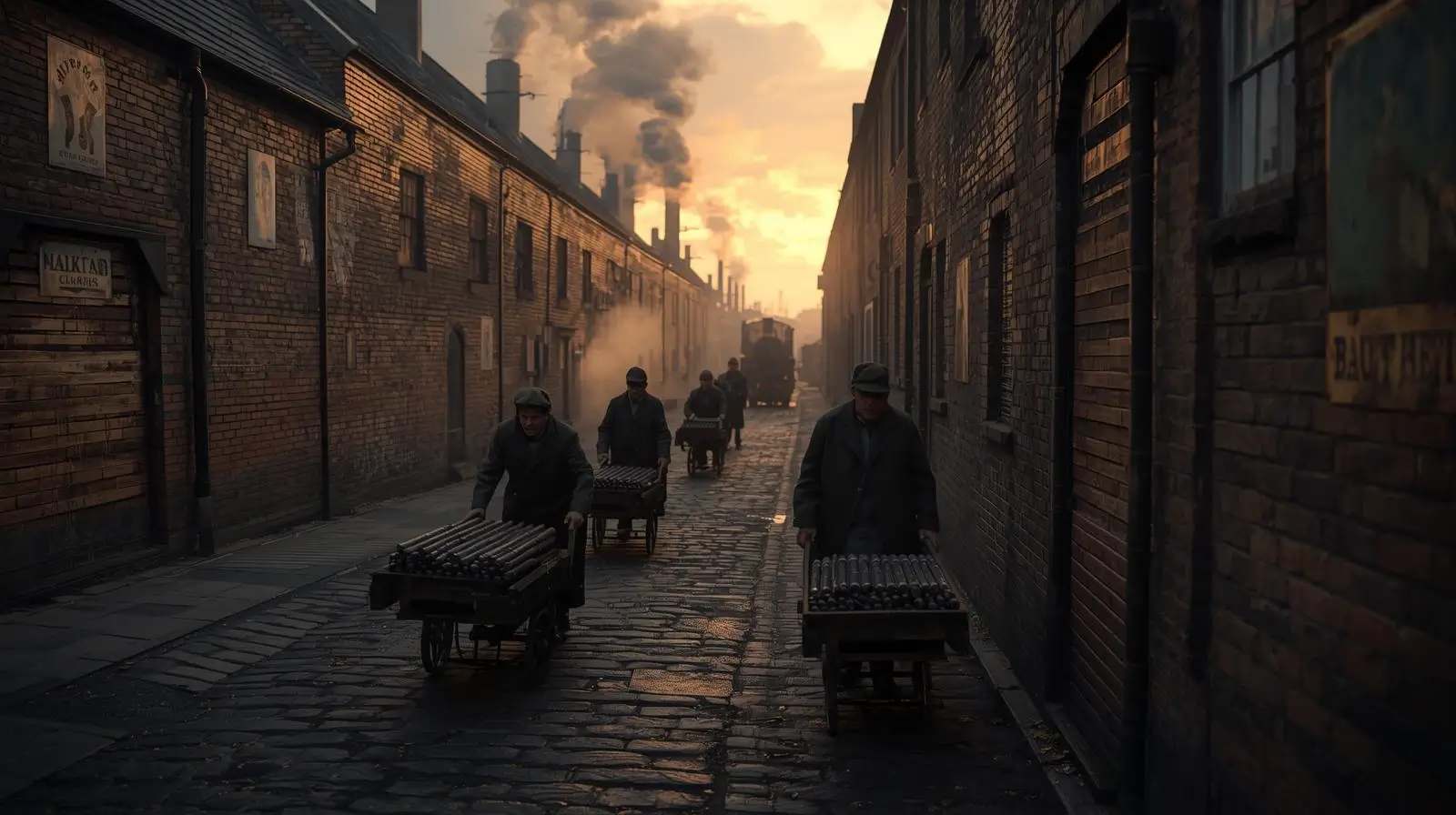
Hundreds of trains and a tide of women changed sleepy Crossgates into a wartime commuter hub: Barnbow Halt, a purpose-built wooden platform and the guarded “Cleanway,” funneled shifts of mostly female labour from East Leeds, the coalfield villages and beyond into the factory on an unyielding 24-hour rota.
The National Filling Factory relied on unyielding rail access: timetabled specials carried women workers in three-shift waves, thirty-eight trains a day at peak.
Commuting became industrial choreography — ticket windows, marshals, parcel vans and a nervous discipline before entering shell filling operations. Management tracked arrivals to keep the workforce continuous; nurses and supervisors met newcomers.
This disciplined movement turned local domestic labour into sustained munitions production, linking neighbourhood routines directly to war work.
Feeding the Beast: How Other Factories Supplied Barnbow
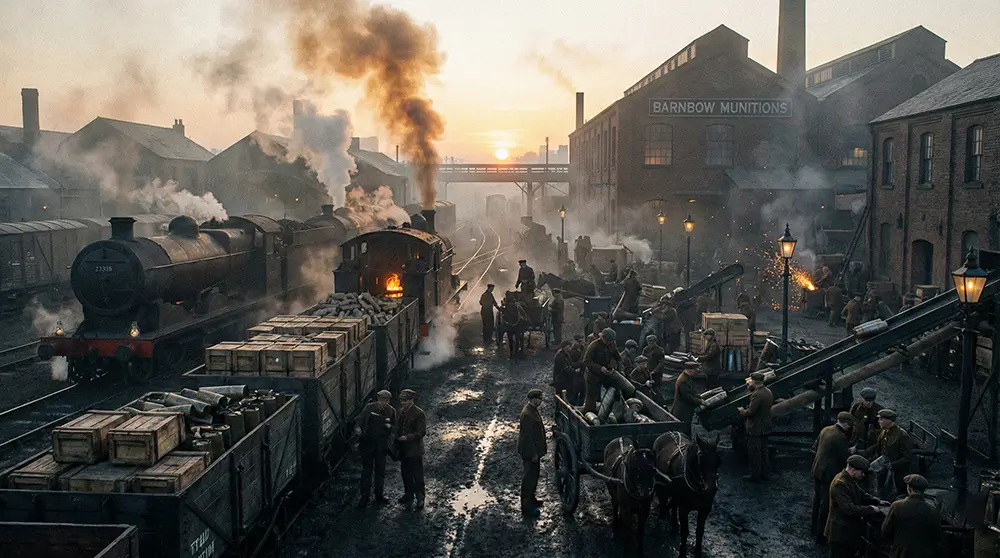
Because Barnbow only assembled and filled shells, its floors depended on a steady, nationwide conveyor of parts and explosives arriving by rail: empty steel cases rolled in from Leeds Forge and other shell-makers, fuzes and primers came from specialist component works, and bulk TNT, ammonium nitrate and cordite were shipped from dedicated explosive factories.
The narrative of supply reads like a timetable: munitions factories across Britain scheduled deliveries into Barnbow’s sidings, coordinated with rail access and internal spurs. Component firms timed production to the shell filling factory’s shifts so the workforce never stalled.
Even when Barnbow built Amatol plants on site, external supplies remained essential. This interconnected production web turned regional factories into a single ecosystem feeding the war effort with unyielding, precise logistics.
Inside the Filling Rooms: From Empty Case to Packed Shell
One steady sequence of operations turned raw components into battle-ready ordnance: workers inspected and cleaned incoming steel cases, measured and prepared explosive charges in heated incorporating houses, and then filled, cooled and finished each shell in tightly controlled stages.
Inside the Barnbow munitions factory, shell filling operations moved like clockwork across filling factory buildings where female munitions workers handled cordite, Amatol and fuzes with practiced care.
Rooms were segregated to limit explosion risk; magazines, presses and inspection benches sat between ventilated sheds.
The site had been chosen and factory buildings were quickly constructed to scale, reflecting its role as the first national shell filling factory.
Every completed round was a factory produced demonstration to disciplined labour and unyielding production output.
From Crossgates to the Front Line: Barnbow’s Output in Numbers
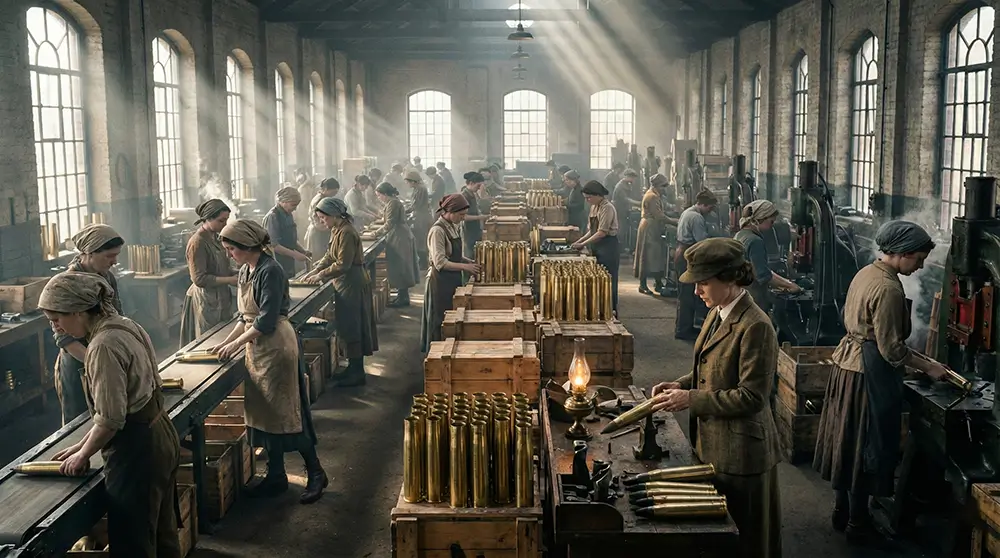
By August 1918 Barnbow was turning out roughly 50,000 filled shells a week, an unyielding output that directly translated the daily arrivals of women from Crossgates and East Leeds into ammunition for the Western Front.
Barnbow, as National Filling Factory No.1, made artillery ammunition on an industrial scale: 24.75 million filled shells and millions more cartridges moved through its sheds, sidings and supply lines.
The women’s workforce operated three shifts, converting incoming cases, fuzes and explosives into battle-ready rounds.
Wartime output depended on a national web of suppliers; Barnbow finished what others forged.
Numbers here read like logistics and like lives—munitions workers kept guns firing, trains carried both commuters and crates, and each statistic concealed human labour and risk.
- Exhaustion and dignity entwined daily.
- Trains brought mothers; trains took shells.
- Silent figures behind roaring guns.
Legacy: East Leeds, Crossgates and a “Hidden” Front Line
Though the guns fell silent in November 1918, the terrain of East Leeds and Crossgates had been permanently altered by the unyielding tempo of Barnbow’s production; fields became factories, rail spurs and magazines scarred the map, and whole communities reoriented their rhythms around shift times and sidings.
The legacy endured: former farmsteads bore silent foundations of a shell filling factory, while Barnbow workers — mostly women — carried memories of tireless war work and astonishing production output.
Local streets remembered trains of munitions workers arriving at dawn and leaving at night, a hidden front line that blurred civilian and military geographies.
Public commemoration lagged behind; only later did plaques and oral histories begin restoring these uncelebrated labourers to the First World War narrative.
Conclusion
Barnbow’s story shows how East Leeds and Crossgates became a single, humming organism bending local lives to a national purpose. Trains, guarded footpaths and Barnbow Halt moved thousands; distant factories fed its filling rooms; skilled hands turned empty cases into millions of deadly parcels. The scale was thunderous, almost unimaginably vast, yet the work was intimate and precise. Its legacy endures in terrains, records and the quiet memory of a community that kept Britain’s war machine going.

FAQs About Barnbow Shell Production
What was the barnbow munitions factory and its role as a munition centre during WW1?
The barnbow munitions factory was a major shell filling factory at Barnbow established after the declaration of war with Germany to meet the urgent need for large volumes of arms and munitions. Built as one of the first purpose-built shell filling operations, No.1 Barnbow and adjacent works handled massive volumes of high explosive and amatol filling operations between 1914 and 1918. The factory complex was served by tracks directly into the factory so shell cases and other materials could be brought directly to the factory gates, allowing rapid movement of raw materials and finished munitions to the Royal Ordnance and distribution networks.
How did filling factories like Barnbow expand quickly in 1915 and 1916?
Massive factory buildings were quickly constructed as demand rose in 1915 and 1916, with the new factory and construction of the first national shell works occurring in response to urgent front-line requirements. By August 1915 and October 1916 the factory at Barnbow and other munitions factories had expanded to include multiple filling sheds, storage, and transport connections. The Ministry of Munitions coordinated expansion and the Leeds Munitions Committee and Leeds Forge Company came from Leeds to help supply equipment and labour to scale up production.
Who were the factory workers and barnbow lasses in the social history of the plant?
The workforce was largely factory workers including many young women known as the Barnbow Lasses who stepped into roles previously reserved for men. The organisation of the factory staff was meticulous: teams handled high explosive filling, shell casing preparation and quality checks. The social history of the site highlights sacrifice of the munitions workers, long shifts, the canteen provision, and how factory staff was based in nearby communities and came directly into the factory complex each day.
What tragic accidents and explosions occurred at the Barnbow filling factories?
Accidents at the factory and explosions occurred during the intense shell filling operations. A notable explosion in December 1916 caused significant loss and was heard across the area; reports from October and December 1915 record other incidents during peak production. These events are central to the social history and the story of Barnbow, prompting improvements in safety while underscoring the dangers faced by those working with high explosive and amatol in the shell factory between 1914 and 1918.
How were supplies and food, like 120 cows and 300 gallons of milk, organised for the factory at Barnbow?
Barnbow had its own farm and logistical arrangements to support the workforce and sustain high production volumes. Stories record that 35 women and local suppliers, including 120 cows producing up to 300 gallons of milk, came from Leeds and nearby farms to help feed workers in the canteen. The factory complex to transport food and raw materials included tracks directly into the factory so perishable supplies could be delivered to workers directly to the factory gates.
What was the relationship between Barnbow and organisations such as the Leeds Forge Company and the Ministry of Munitions?
The Ministry of Munitions oversaw national shell production while the Leeds Forge Company and Leeds Munitions Committee supported local manufacture and supply. The Leeds Forge Company supplied metalwork and components, and the Leeds Munitions Committee helped recruit and organise workers. Together they integrated the factory into national volumes of arms and munitions, helping the barnbow munitions factory meet the urgent need for large volumes demanded by the First World War.
How did transport and tracks directly into the factory help shell production at Barnbow?
Efficient transport was essential: tracks directly into the factory complex allowed shell cases and other materials to be moved swiftly to filling sheds and storage. The factory was served by rail and dedicated sidings, so workers and supplies could reach the eastern side of the factory quickly and finished munitions could be sent on to depots or the Royal Ordnance. This layout enabled high daily outputs and supported shell filling operations to start and scale up as front-line demand increased.
What happened to the Barnbow factory and its workers by the end of the war?
By the end of the war, production at the Barnbow factory decreased as the urgent need for volumes of arms and munitions waned. The site, which had included cartridge factory functions, high explosive and amatol filling, and massive factory buildings, gradually wound down operations. Many factory workers returned to civilian life; the social history remembers the contribution and sacrifice of the Barnbow Lasses and all staff, while the story of Barnbow remains a key example of wartime industry, community support and the scale of national mobilisation during the First World War.