
Women kept Britain functioning by stepping into munitions, transport, agriculture, nursing and administration, freeing men for the front and sustaining military capacity. By 1918 about seven million women were in paid work, with over a million in munitions and 20–23,000 in the Women’s Land Army, despite dangerous conditions and health risks.
Their service reshaped gender roles, aided the war economy, and influenced postwar politics. The following sections provide detailed evidence and personal stories.
Key Takeaways
- Millions of women moved into paid work, replacing men and keeping factories, transport, and services running during the war.
- Over one million women worked in munitions, producing essential weapons and ammunition despite hazardous conditions.
- Women served in uniformed and voluntary roles—nurses, VADs, WRNS, ambulance drivers—supporting medical care and military logistics.
- The Women’s Land Army and agricultural labourers maintained food production amid male workforce shortages.
- Wartime employment expanded skills and public roles for women, influencing the 1918 franchise extension and postwar social change.
What was the role of the home front in Britain during the First World War?
Women on the home front became the backbone of Britain’s war production, staffing munitions factories, railways, farms and hospitals to keep the army supplied. By 1918 millions were employed in these roles, significantly altering labour patterns and creating new opportunities in engineering, administration and public service. Their work sustained the war effort, increased the size of the female workforce, and opened wartime roles that later developed into lasting career paths.
How did women’s work on the home front support war production?
Although the guns fired in France, Britain’s war machine depended on the labour, skill, and endurance of women at home who stepped into roles essential for sustaining front-line operations. Women’s work altered war production in several ways: munitions workers in filling factories risked explosions and poisoning, while women joined factories, shipyards, and transport to keep supply chains operating. Administrative, nursing, and agricultural roles freed men for combat and directly supported the war effort. Evidence shows that these home-front roles played a significant part in maintaining Britain’s military capacity and reshaping women’s lives.
How many women were employed on the home front by 1918?
By 1918 roughly seven million women were engaged in paid work in Britain — an increase of about two million since 1914 — with thousands more serving in voluntary roles. Women were employed across sectors including filling factories, transport, clerical services, and the Women’s Land Army. Contemporary statistics highlight a patriotic, organised national response that sustained industry, agriculture and administration in 1918.
What opportunities for women emerged from wartime roles on the home front?
The employment of roughly seven million women by 1918 opened lasting opportunities. Women working in munitions, transport, and the Women’s Land Army demonstrated their competence in wartime production and technical tasks. Those serving as clerks, engineers, nurses, and farm labourers displaced parts of the male labour force and created new roles previously denied to them. These shifts challenged traditional gender roles, expanded vocational training, and pressured employers and politicians to recognise women’s skills and responsibilities. Although post-war retrenchment occurred, significant precedents for expanded opportunities had been established.

How did munitions factories shape the war effort in WW1?
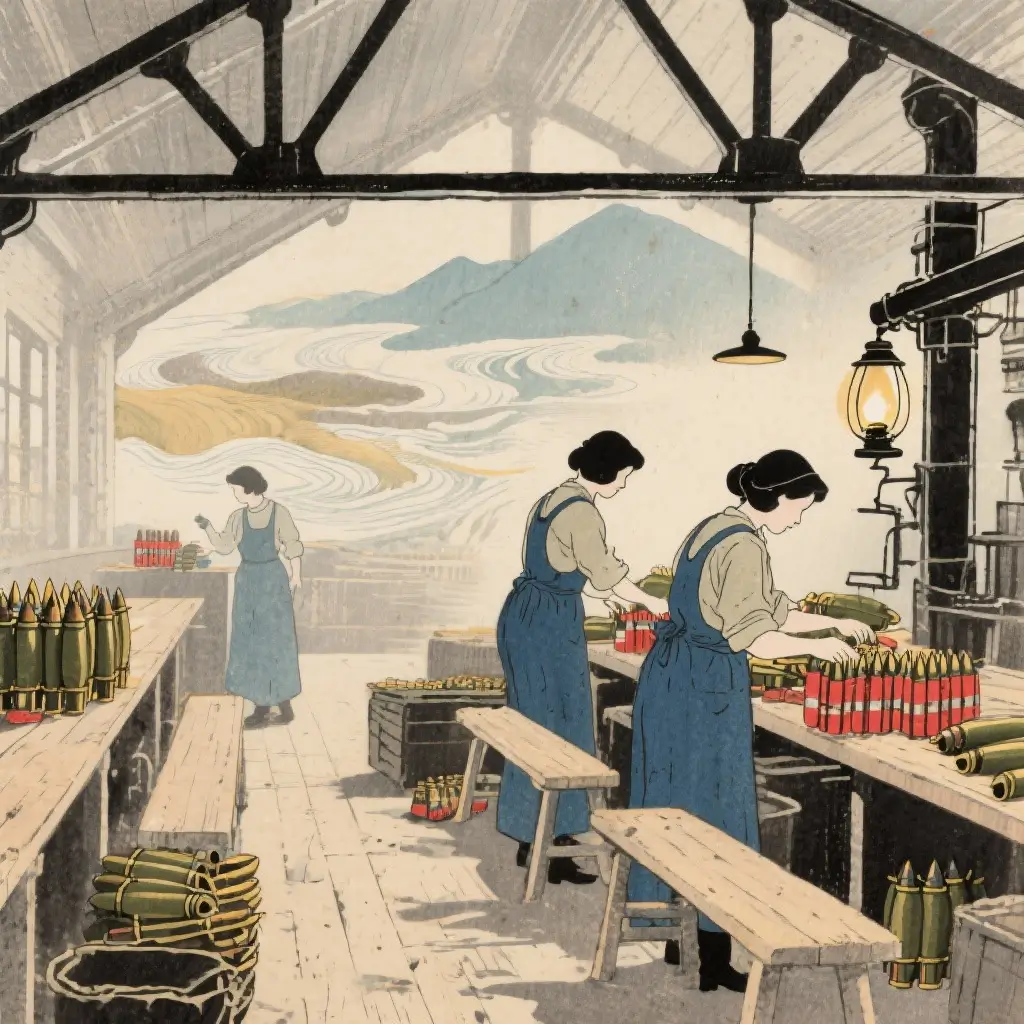
Munitions factories became both lifeline and hazard on the home front. Long shifts, exposure to TNT and volatile explosives, and frequent accidents cost many lives. The surge in shell and weapons production between 1915 and 1918 pushed many women into skilled, paid industrial roles and reshaped social expectations. By 1918 hundreds of thousands of women were employed in war materials production — a numerical and economic shift that directly sustained the Western Front.
What were the dangers and daily life of munition workers?
Munitions factories were indispensable arteries of Britain’s wartime industry, and the women who staffed them faced constant danger and exhausting routines. Work in filling factories required speed and precision in handling TNT and assembling shells. Accidents were frequent: explosions, chemical burns, and chronic poisoning were common. Daily life mixed hazardous conditions with regimented shifts, strict safety rules, and limited welfare provisions. Injury rates were high, yet women kept shells flowing to the front.
Daily realities included:
- Long shifts in noisy, hazardous halls
- TNT poisoning symptoms
- Fire and explosion protocols
- Medical and welfare provisions
How did factory work change women’s lives and roles in 1917–1918?
As munitions factories expanded in 1917–1918, millions of women transitioned from domestic or peripheral work into indispensable industrial employment, reshaping daily routines, social status, and political expectations. Their labour sustained the British Army with a constant supply of shells and munitions and demonstrated women’s capacity for technically skilled, disciplined industrial work. Wartime employment provided new training, authority, and independence, and linked female workers with agricultural and engineering roles. Resilience and adaptability defined women’s contribution to the wartime home front.
How did war materials production affect the number of women working?
War materials production significantly increased the number of women entering heavy industry in 1917–1918. Wartime demand for munitions, artillery shells, and industrial output drove mass recruitment into filling factories, shipyards, and government departments. Others joined the Women’s Land Army or voluntary services. Women’s labour sustained logistics, production rates, and morale, reshaping gendered labour norms during acute national need.
Contributing factors included:
- Rapid expansion of filling factories
- Transfer of women into heavy industry
- Official recruitment and training schemes
- Continued voluntary and agricultural labour
What was the Women’s Land Army and how did land girls help the war effort?
The Women’s Land Army (WLA), organised in 1917, replaced absent male farm labourers and maintained food production. Land Girls carried out essential agricultural tasks such as ploughing, harvesting, milking and livestock care, making large-scale food production viable. The WLA contributed significantly to sustaining the agricultural economy and national survival during wartime shortages.
What tasks did women in the Women’s Land Army perform?
The Women’s Land Army recruited thousands of Land Girls to perform essential agricultural work, including ploughing, sowing, harvesting, milking, poultry-keeping and maintaining livestock. Their duties were practical, varied, and crucial to national survival and the broader war effort.
How many Land Girls served and how were they recruited?
Approximately 20,000–23,000 women served in the First World War WLA. Recruitment combined local boards, public adverts, and voluntary enlistment. Training was practical and rapid. Their contributions helped stabilise the agricultural economy by performing tasks such as ploughing, harvesting, and livestock management.
Did the Women’s Land Army continue into the Second World War?
Yes. The Women’s Land Army was reconstituted in 1939 to meet renewed food shortages and support the agricultural economy. Land Girls performed similar tasks to those of WWI — ploughing, harvesting, animal husbandry, and food preservation — helping mitigate import losses from U-boat attacks and stabilising domestic supply chains.
How did women serve in voluntary and uniformed roles during World War One?

A wide range of voluntary and uniformed services emerged, including the Women’s Royal Naval Service, Queen Alexandra’s Imperial Military Nursing Service, Voluntary Aid Detachments, ambulance units, and auxiliary transport corps. Women served in roles formerly closed to them, including clerical posts, ambulance driving, and frontline nursing. Service records, government reports, and personal memoirs show how these roles reshaped gender norms and strengthened Britain’s wartime infrastructure.
Which women’s services existed, such as the Women’s Royal Naval Service and ambulance units?
Several formal and voluntary services operated during WWI, including:
- Voluntary Aid Detachments (VADs)
- Women’s Royal Naval Service
- Women’s Land Army
- American Red Cross ambulance units
These organisations filled clerical, logistical, and medical roles, supporting both civilian and military operations across Britain and overseas.
What motivated thousands of women to become workers and volunteers?
Necessity, duty, and opportunity motivated women to enter paid work and voluntary service. Economic need, patriotic appeals, and the desire to support loved ones at the front drove many into munitions, agriculture, transport, nursing, and administrative roles. Recruitment drives reached millions and intersected with wider suffrage debates. Practical motives such as wages, skill acquisition, and stable employment also played major roles.
What was the social and political impact of women’s wartime involvement?
Women’s mass employment during the war helped precipitate the 1918 extension of the franchise and shifted parliamentary rhetoric regarding citizenship and service. Wartime skills, pay, and workplace experience changed expectations for women’s postwar opportunities, even as demobilisation policies attempted to return them to domestic roles. Public attitudes evolved between 1918 and 1939, with growing acceptance of women in industrial and administrative work.
Did women’s work on the home front contribute to women’s suffrage?
Women’s wartime service significantly influenced political debates surrounding the Representation of the People Act (1918). Although the connection was not purely causal, women’s competence in essential industries, statistical labour shifts, and increased public respect contributed to the argument for extending political rights. The correlation between wartime service and suffrage reform is widely recognised.
How did wartime employment change women’s lives after the war?
Wartime employment left a lasting impact on women’s lives. Skills gained in munitions, nursing, agriculture, and engineering roles expanded expectations for equality and independence. Wartime service provided political leverage in postwar debates about civil rights and employment policies. Although many women were pushed back into traditional roles after the war, the Home Front permanently altered gendered labour norms and political claims.
How did public perception of women workers evolve between WWI and WWII?
Public perception evolved from initial surprise to recognised respect, tempered by economic anxieties and fears of job displacement. Women’s visible competence in industrial, agricultural, and administrative roles challenged gender norms and influenced political thinking about citizenship and worker rights. Their wartime labour shaped attitudes leading into the Second World War.
How is the history of women on the home front documented and remembered?
The history of wartime women is documented through National Archives factory records, Ministry of Munitions files, VAD and WLA service papers, government labour statistics, oral histories, and local memorials. Historians combine these sources to reconstruct women’s roles in munitions, nursing, agriculture, and transport, and to assess the social and political consequences of their labour.
Where can primary sources be found in the National Archives?
Primary sources include:
- Ministry of Munitions files
- War Office service rolls
- Home Office and local government records
- Photographic and press archives
These records provide data on factory work, service postings, wages, recruitment, and political debates surrounding women’s contribution to the war effort.
What statistics show women’s employment in wartime industries?
Government returns show over one million women in munitions by 1918, 700,000 in transport and communications, and hundreds of thousands in domestic, agricultural, and clerical roles. These statistics, drawn from Ministry of Munitions reports, Board of Trade labour records, and census supplements, quantify the scale and shift of women’s employment.
How have historians remembered women’s roles on the home front?
Historians have reconstructed the experiences of women workers using government returns, local archives, oral testimonies, newspapers, memoirs, and museum collections. Their work demonstrates how women’s labour sustained the war effort and shaped social change during and after the First World War.
Conclusion
Women kept Britain functioning through unparalleled upheaval, from munitions factories to markets, and hospitals to harvests. Their labour was not marginal: by 1918, approximately 80% of munitions workers were women — a striking statistic demonstrating how deeply they powered the war effort. This contribution reshaped workplaces, accelerated social change, and advanced the cause of political rights. Remembering these facts helps illuminate the realities of wartime Britain and the enduring legacies women left behind.