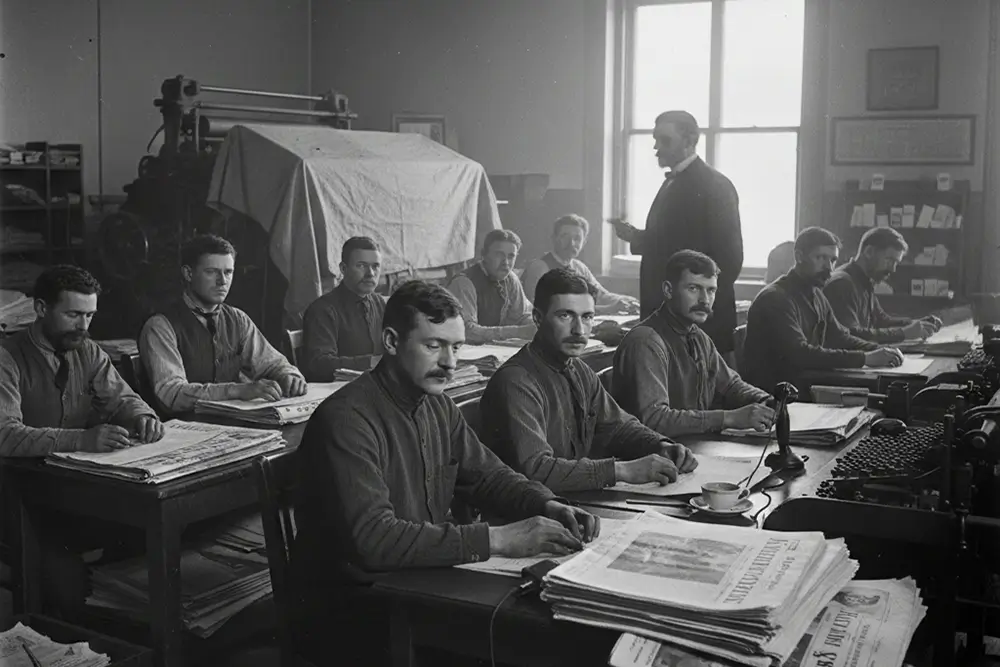
World War One Censorship – During the First World War, British authorities and newspapers worked closely under laws like DORA to suppress unsettling facts and craft upbeat narratives. Editors self-censored to avoid prosecution and protect morale, while officials directed propaganda and banned images or reports that might weaken unity.
Casualties, industrial mishaps and psychological tolls were often euphemized or omitted, reshaping public memory and silencing many costs of conflict. Continue for an account that uncovers what was kept out of sight.
Key Takeaways
- Wartime laws and the Defence of the Realm Act empowered authorities to censor publications, seize materials, and prosecute dissenting journalists.
- Editors practiced self-censorship to avoid legal penalties, aligning reporting with government expectations and suppressing uncomfortable truths.
- Coordinated propaganda and press cooperation sanitized casualty lists, staged images, and omitted battlefield horrors to protect public morale.
- Euphemistic language and selective omissions obscured psychological trauma, industrial accidents, and broader social harms from public view.
- Long-term silence and curated narratives reshaped collective memory, muted grief, and influenced commemoration and veteran policy.
The Defence of the Realm Act (Dora) Wartime Control
When war began, Britain didn’t rely on informal pressure alone: Parliament granted the executive sweeping legal powers under the Defence of the Domain Act, which let authorities restrict publications, seize materials, and prosecute perceived threats to the war effort.
That legal structure made censorship systematic, setting boundaries for information suppression and shaping public comprehension. Officials argued wartime control was essential to protect morale and the national crisis response; they coordinated propaganda and expected media cooperation.
Censorship became systematic, defining what could be said and shaping public understanding to protect morale.
Editors learned to balance public service with legal risk, altering coverage to avoid prosecution. For those committed to serving others, the law posed a dilemma: protect collective resilience or expose truths that might aid reform.
The Defence of the Realm Act thus redefined responsibility and constrained how Britain could speak about the war.
British Press Censorship During the First World War
Although legally authorized to curb threats to morale, British authorities relied heavily on the press itself to police wartime reporting, and editors—facing prosecution under DORA and a pervasive expectation of restraint—regularly self-censored to avoid conflict with officials. The British press balanced service to community with obedience, choosing silence over stories that might harm morale.
Wartime censorship blended censorship and propaganda: officials guided headlines; editors practiced media cooperation, shaping a public narrative that prioritized endurance. That cooperation spared prosecutions but erased painful realities. Serving readers meant protecting them, yet it also withheld truths.
The Defence of the Domain Act framed limits; journalists learned to omit rather than contest. This cautious stance reshaped memory of the First World War.
What the Public Was Shown and What Was Hidden – Atrocity Propaganda
Because officials and editors wanted to protect morale, the public mostly saw a curated war: headlines of heroic advances, sanitized casualty lists, and carefully staged photographs that emphasised resolve rather than ruin.
The press, guided by censorship and the Defence of the Domain Act, presented a public narrative that doubled as propaganda. Editors suppressed images and reports that might erode wartime unity: mass graves, shell shock, industrial war wounds, and the full human cost of battles.
Silence replaced scrutiny; families received terse casualty notices while broader social harms stayed hidden. Those who served community needs—nurses, aid workers, local organizers—had to work within that constrained comprehension.
Silence supplanted inquiry: brief casualty notices masked wider social wounds, leaving caregivers to act within limited public understanding.
Recognising what was omitted helps servants of public memory restore neglected truths and honour overlooked suffering.
Language, Morale, and the Politics of Framing with David Lloyd George
If words were weapons, wartime Britain wielded them deliberately: officials and editors chose phrases that steadied nerves, channelled anger, and turned loss into duty, so public speech itself became a mode of control.
The state linked censorship to protecting morale, and newspapers accepted a shared duty to the war effort. David Lloyd George Language shifted from reporting to guidance: euphemisms masked slaughter, praise replaced critique, and silence covered industrial accidents tied to wartime production.
Propaganda and restrained reporting produced a public narrative that prioritised endurance over truth. That framing eased immediate strain but hid the psychological toll on soldiers, families, and workers.
Citizens motivated to serve were asked to trust media cooperation, yet they also deserved clearer accounts to repair harm and honour sacrifice.
The Press as Partner in National Unity
When the government cast the press as an essential ally, many newspapers answered the call and folded national unity into their pages; editors and proprietors framed reporting not merely as information but as a civic duty, curating stories to enhance resolve, smooth dissent, and present a steady front.
The press acted with intention: embracing censorship and shaping propaganda to protect morale and sustain the war effort. Journalists balanced duty to readers with claims of national interest, preferring omission to risk harm.
That cultivated silence altered public perception, narrowing what communities could know and support. By choosing a unifying narrative, newspapers helped mobilise consent and care for those serving, but they also limited debate about means, costs, and consequences.
The Human Costs Erased From Public View
Having helped shape a steady narrative of duty and unity, the press also helped cut entire human experiences out of public sight.
It practised wartime censorship that narrowed public comprehension, turning casualty reporting into numbers and euphemisms. Editors and officials coordinated silence as part of propaganda efforts to protect morale, but that protection came at human cost. Families got telegrams without explanation; survivors returned with wounds and a psychological toll nobody named.
Wartime censorship reduced lives to euphemisms and numbers, silencing wounds and the private costs of morale.
Industrial accidents at munitions plants were minimised or buried to avoid unrest. Those serving others—nurses, relief workers, community organisers—met needs the public narrative ignored.
A sober reckoning with censorship shows how omission reshaped sympathy, hid suffering, and limited society’s ability to respond compassionately to wartime harm.
Memory, Silence, and the Long-Term Impact
Because silence was deliberate, collective memory of the war was shaped as much by what wasn’t said as by official accounts, and that absence left lasting gaps in public comprehension.
Historians note that censorship and propaganda didn’t just protect morale during a national crisis; they carved out omissions that became permanent.
The press’s restrained reporting of casualties and wartime production mishaps muted grief and skewed the public narrative. Families, carers, and communities who served others found their losses undervalued; survivors bore the psychological toll with little language or recognition.
Over decades, that engineered silence influenced commemoration, education, and policy, making it harder to address veterans’ needs, factory safety, or mental health.
Remembering requires naming what was silenced.
Conclusion
Censorship and silence stitched a selective story, shaping a stoic social spirit that sidelined suffering. Press partners polished problems, portraying progress while pushing pain into private places. Language laboured to lift morale, leaving mutilation, madness and mourning muted. Memory melted into managed myth, making mourning a muted, mediated matter. Yet suppressed stories simmered, seeding slow shifts in remembrance; ultimately, truth trickled through the seams, sparking sober, social scrutiny of that curated wartime consciousness.
FAQs About world war one censorship in Britain
How did censorship shape British public opinion at the start of the great war and outbreak of war in 1914?
At the outbreak of war in 1914 the British government quickly introduced censorship to control information and shape public opinion. Newspapers, letters and postcards were monitored to prevent the publication of military details and to suppress criticism of the war. This control of propaganda helped sustain patriotism and support for Britain and Germany’s opponent narratives, limiting reports of German atrocities and the horrific nature of trench warfare until official channels allowed fuller disclosure.
What role did the War Office, official press bureau and war propaganda bureau play in domestic propaganda during the first world?
The War Office, together with the Official Press Bureau and the War Propaganda Bureau, coordinated what became a broad propaganda machinery. They guided editors, issued press briefings, and worked with figures such as Lord Northcliffe to influence the power of the press. Their propaganda work aimed to boost recruitment, maintain morale on the home front and justify war aims to both British people and neutral countries.
How were postcards, postal workers and troop mail handled to prevent sensitive information reaching enemy countries or the public?
Postal censorship screened postcards and letters sent to and from troops at the front. Postal workers and military censors removed tactical details, locations and casualty lists that might benefit the German army or lower home front morale. This postal control extended to letters from the front and censored articles in newspapers to avoid inadvertently revealing troop movements or trench positions.
In what ways did coverage of the battle of the somme and the horrific nature of trench warfare get altered by censorship in 1916 and january 1916 or february 1916?
Censors restricted graphic descriptions and photographs of the Battle of the Somme and other engagements to prevent public shock and maintain recruitment. Reports were sanitized in 1916 (including January and February) so that the full scale of casualties and the horrific nature of trench warfare were underplayed. When details did emerge they were often framed to emphasize bravery and sacrifice rather than strategic failures.
How did officials respond to criticism of the war, anti-German sentiment and reports of German atrocities between 1915 (may 1915) and 1917?
From May 1915 onwards, censorship suppressed overt criticism of the war while promoting anti-German sentiment through controlled releases and propaganda campaigns. Reports of German atrocities were used selectively to justify the war, but direct criticism of policy or the war cabinet was often censored. By 1917 and into December 1917, authorities balanced exposing enemy crimes with preventing demoralizing domestic dissent.
What influence did figures like Lord Kitchener, Lord Northcliffe and the editor of the Daily Mail have on British propaganda and the propaganda campaign?
Prominent figures shaped the shape and reach of British propaganda. Lord Kitchener’s recruitment posters and Lord Northcliffe’s press influence—notably via the Daily Mail and its editor—helped mobilize public support. They worked alongside official organisations like the National War Aims Committee to deliver coordinated propaganda campaigns, using the power of the press and form of propaganda suited to mass audiences.
How were war correspondents and foreign propaganda managed to protect military secrets while informing the British public?
War correspondents were accredited and their dispatches vetted by censors to prevent revealing sensitive information. Foreign propaganda efforts were coordinated with allied messaging to influence neutral countries and counter German propaganda. Correspondents were sometimes embedded under strict rules; reporting was shaped to support official narratives while still conveying the progress of the war.
Did censorship affect reporting about the end of the war, february 1918 developments, and events in 1918 more broadly?
Censorship continued through 1918 to manage the transition from conflict to peace. Reports on the end of the war and key 1918 developments were controlled to maintain public order and shape the political narrative about victory and war aims. Sensitive negotiations and the state of the German army were carefully managed in public communications to avoid unrest during demobilisation.
How did censorship intersect with patriotism, recruitment, and the portrayal of the German enemy and german soldiers during the first world war?
Censorship reinforced patriotism by controlling negative or critical portrayals of the war and amplifying stories of heroism to encourage recruitment and support for war aims. The German enemy and German soldiers were often depicted in stark terms—sometimes exaggerated as part of a propaganda in world war strategy—to justify sacrifice and sustain public morale, while more nuanced or critical coverage was suppressed.