
How War Reached the British Home Front
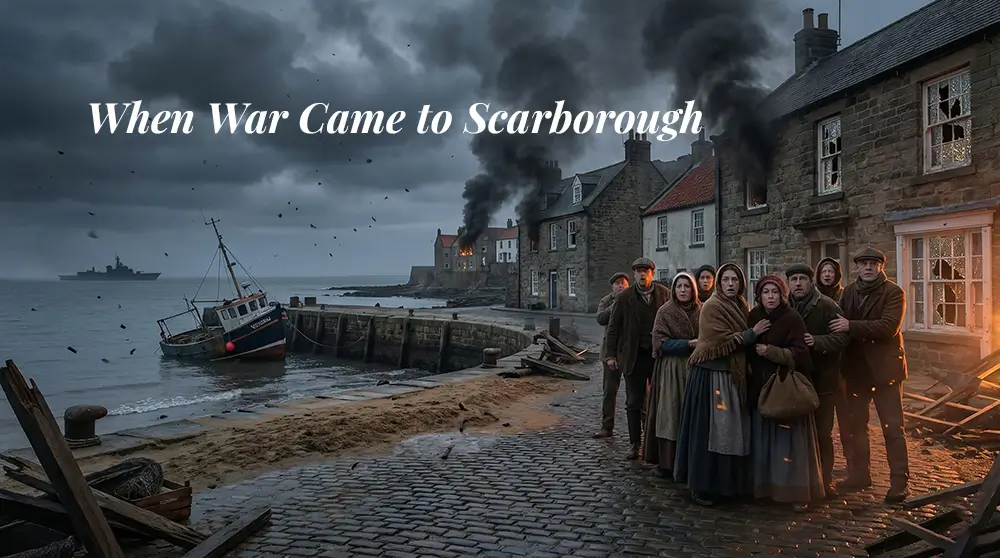
Scarborough Bombardment 1914 – The German bombardment of Scarborough on 16 December 1914 marked the first time many Britons realised the war would not remain confined to distant battlefields. In a coordinated naval raid on Britain’s east coast, German battlecruisers shelled the town in broad daylight, striking historic landmarks, hotels, churches, and residential streets.
Although Scarborough held little direct military value, the attack caused civilian deaths, widespread destruction, and profound psychological shock. Eighteen civilians were killed in the town, including women and children, and more than 200 buildings were damaged. The raid shattered assumptions of domestic safety and forced the British public to confront the reality of a vulnerable home front.
Key Takeaways on First World War Naval Bombardment of Scarborough
- On 16 December 1914, German naval forces shelled Scarborough during a wider raid on Scarborough, Hartlepool, and Whitby.
- The bombardment targeted prominent civilian landmarks and residential areas rather than military installations.
- 18 civilians were killed in Scarborough, with many more injured or displaced.
- Press coverage framed the attack as psychological warfare and a breach of international law.
- The raid accelerated recruitment, reshaped public opinion, and prompted urgent coastal defence reforms.
- Scarborough became an enduring symbol of civilian vulnerability in modern warfare.
Scarborough Before the War
Before the bombardment, Scarborough was a thriving seaside resort balancing tourism, fishing, and maritime trade. Hotels along the South Cliff remained open despite wartime uncertainty, promenades were still used by residents and visitors, and family life followed familiar routines.
Like much of Britain, Scarborough’s population largely believed the war would be fought “over there” — in France and Belgium. Early patriotic enthusiasm encouraged enlistment, but daily life continued with minimal disruption. The town had no significant coastal defences, no heavy guns, and no expectation of direct attack.
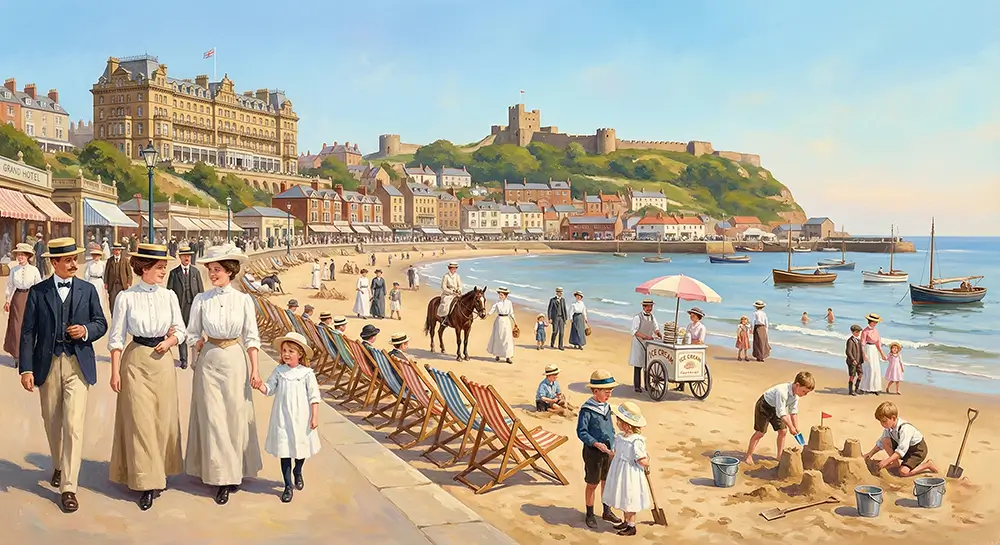
Local newspapers and personal letters show complacency about direct attack and little expectation of civilian casualties. The town’s social fabric — hotels, shops, churches and working-class streets — conveyed normality that would make any sudden wartime violence both shocking and deeply disruptive.
Idealic Summer of 1914 before the war Scarborough Bombardment 1914
The contrast between Scarborough’s peaceful pre-war atmosphere and the violence of December 1914 was stark. In the summer of 1914, the town hosted holidaymakers drawn by clean sea air, theatres, beaches, and the imposing Grand Hotel overlooking the bay.
Hotels, boarding houses, churches, and tightly packed working-class streets formed a dense social fabric. This concentration of civilian life meant that when shellfire arrived, destruction was immediate and intimate. Homes, shops, and places of worship — symbols of normality — became sites of death and trauma.
The bombardment’s shock lay not only in physical damage, but in how suddenly everyday civilian spaces were transformed into targets.
Why Scarborough Was Targeted by the German Navy
Scarborough’s selection raised immediate legal and moral questions. The town was undefended and lacked significant military infrastructure, making its bombardment controversial even by contemporary standards.
German strategy under Admiral Franz von Hipper sought to:
- Demonstrate German naval reach
- Undermine British morale
- Draw British naval forces into a wider engagement
- Exert political pressure on the Royal Navy through public outrage
Scarborough’s visibility as a civilian resort amplified the psychological impact. Its bombardment was designed to be felt far beyond the Yorkshire coast.eliberate psychological target. The shelling of civilian landmarks was intended to shock, not conquer.
Civilian Targets and International Law
Naval warfare in 1914 operated under the Hague Conventions, which restricted bombardment of undefended towns and sought to protect non-combatants. The shelling of Scarborough immediately triggered accusations that Germany had violated these principles.
British officials and newspapers argued the raid constituted deliberate psychological warfare, aimed less at military targets than at terrorising civilians. Images of damaged homes and dead children featured prominently in national press coverage.
German authorities defended the attack by citing naval necessity and Britain’s failure to defend its coast. Historians now largely agree that Scarborough became an early test case in the erosion of civilian immunity during modern warfare.
The Morning of 16 December 1914
The Morning of 16 December 1914
At approximately 8:00 a.m. on 16 December 1914, German battlecruisers SMS Derfflinger and SMS Von der Tann opened fire on Scarborough from offshore positions in the North Sea.
The shelling lasted around 25 to 30 minutes. Residents were caught completely off guard. Families fled breakfast tables, children ran from schools, and civilians crowded into cellars as shells fell across the town.
Where the Naval Guns Shells Fell
Shells struck a wide arc through Scarborough, including:
- Scarborough Castle, where medieval walls were pierced
- The Grand Hotel, symbol of the town’s tourist identity
- St Martin-on-the-Hill Church
- Wykeham Street, where four members of the Bennett family were killed
- Residential streets in the Old Town and South Cliff areas
More than 200 properties were damaged. Churches, hotels, shops, and working-class homes bore the brunt of the attack, reinforcing the civilian character of the damage.
Civilian Casualties and Human Cost
Eyewitness accounts describe panic, disbelief, and chaos. Civilians fled through streets strewn with debris, many believing invasion was imminent. Some residents escaped barefoot or in nightclothes, seeking shelter in open countryside.
Doctors, nurses, and volunteers treated the wounded as best they could amid limited facilities. Emotional shock was widespread, with survivors reporting lasting trauma long after physical wounds healed.
The bombardment killed 18 civilians in Scarborough. Among the dead were women, children, and entire households. The youngest victim was 14 months old; the oldest was 65.
One victim, George Harland Taylor, aged 15, was a Boy Scout struck by shell fragments while running through the streets. He later became recognised as the only Boy Scout killed on British soil during the war.
Dozens were injured, many homes destroyed, and families left homeless within minutes. Relief efforts began immediately, combining emergency shelter, medical care, and the grim task of accounting for the dead.
Britain’s and Royal Navy Response and Public Reaction to the North Sea Attack
The bombardment caused national outrage. Newspapers condemned the attack as barbaric, while politicians demanded explanations for the Royal Navy’s failure to prevent it despite intercepted German signals.
The phrase “Remember Scarborough” became a powerful recruitment slogan. Enlistment surged, and public pressure mounted for stronger coastal defences and clearer naval strategy.
Was the Bombardment Legal?
The raid sparked immediate international outrage.
British newspapers and politicians argued that shelling an undefended town violated the Hague Conventions, which restricted bombardment of civilian populations.
Germany defended the action by claiming:
- The coast was militarily relevant
- Britain bore responsibility for inadequate defence
- Naval warfare allowed coastal bombardment
Historians now broadly agree: Scarborough was targeted primarily for psychological effect, making it an early example of warfare directed at civilian morale.
Shifting Public Perception of the War
Before December 1914, many Britons viewed the war as distant. After Scarborough, that illusion collapsed. Civilians now understood they were potential targets.
The attack reframed the conflict as a domestic crisis as well as an overseas one. The home front became an acknowledged theatre of war, shaping public attitudes for the remainder of the conflict.
The Bombardment in Historical Context
The Scarborough bombardment stands as an early example of total war, in which civilians became directly exposed to military violence. It foreshadowed later Zeppelin raids and air attacks on British cities.
The raid forced Britain to reassess coastal defence and civilian protection, embedding the concept of the home front in national consciousness.
Why the Bombardment Still Matters
Scarborough’s experience demonstrates how modern warfare collapses the boundary between front line and home. Its bombardment revealed how fear, outrage, and civilian suffering could be weaponised.
The event remains central to debates about the legality of targeting civilian areas and the moral limits of warfare.
Scarborough as a Symbol of the Home Front
Scarborough endures as a symbol of Britain’s home-front vulnerability. Its lack of military value underscores the psychological intent behind the attack: ordinary life itself became the target.
Memorials and remembrance practices continue to link local loss to national wartime experience, preserving Scarborough’s role as a warning from the earliest months of the war.
Conclusion
The Scarborough bombardment shattered Britain’s sense of insulation from war. In under half an hour, a peaceful seaside town became a site of civilian death, destruction, and national reckoning.
It marked the moment many Britons understood that modern war would not respect geography, class, or innocence — and that the home front was now inseparable from the battlefield.
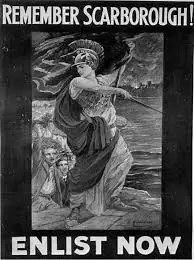
Recruitment surged as patriotic rhetoric portrayed service as defence of communities. At the same time, citizens demanded stronger coastal defences and clearer government assurances.
Public perception shifted from confident detachment to anxious engagement: the war was no longer merely overseas, but an urgent domestic crisis demanding military, political and social responses.
FAQs About The Scarborough Bombardment 1914
1. What was the Scarborough Bombardment?
The Scarborough Bombardment was a German naval attack on the English seaside town of Scarborough on 16 December 1914. German warships shelled the town in the early morning, striking civilian buildings and causing significant loss of life and damage.
2. Why did Germany attack Scarborough?
Scarborough had little military value. It was targeted primarily for psychological impact, as part of a wider German strategy to attack Britain’s east coast and undermine civilian morale by demonstrating that the war could reach British homes.
3. Which German ships were involved?
The bombardment was carried out by ships of the German High Seas Fleet, including battlecruisers such as SMS Derfflinger and SMS Von der Tann, which also attacked other east coast towns that morning.
4. What parts of Scarborough were hit?
Shells struck several prominent and residential locations, including:
- Scarborough Castle
- The Grand Hotel
- Churches, shops, and homes
- Working-class neighbourhoods
Much of the damage occurred in civilian areas rather than military sites.
5. How many people were killed in the bombardment?
The attack on Scarborough killed 18 civilians and injured many more. Those killed included women and children, which fuelled national outrage when the news spread across Britain.
6. How did Britain react to the attack?
Public reaction was one of shock and anger. Newspapers condemned the raid, and the phrase “Remember Scarborough” was widely used in recruitment campaigns. The attack also led to increased coastal defences and a shift in how civilians viewed the war.
7. Why is the Scarborough Bombardment historically important?
The bombardment marked a turning point in Britain’s home-front experience. It showed that civilians were no longer protected from modern warfare and foreshadowed the wider targeting of civilian populations later in the war, including air raids and total war strategies.