
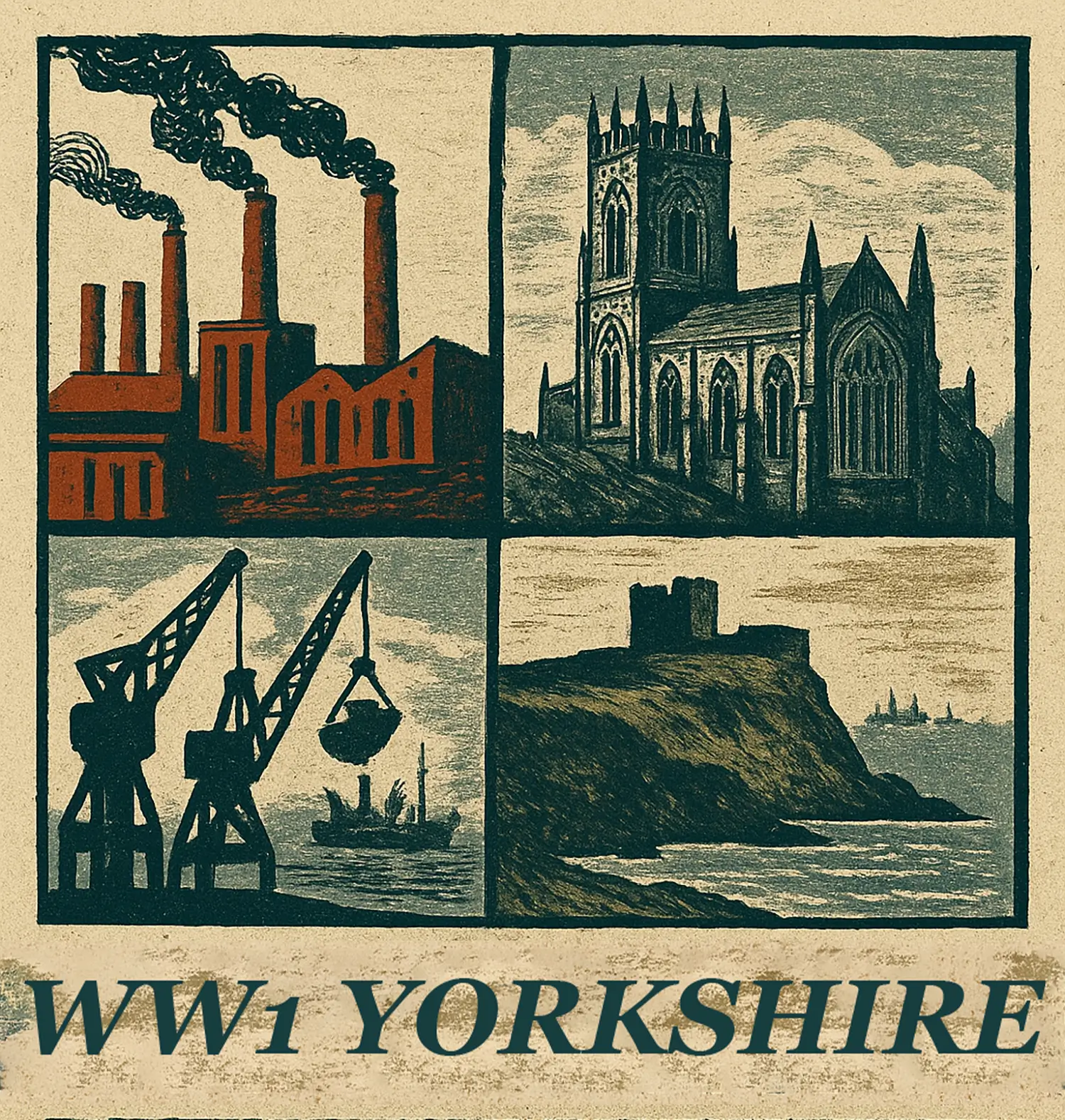
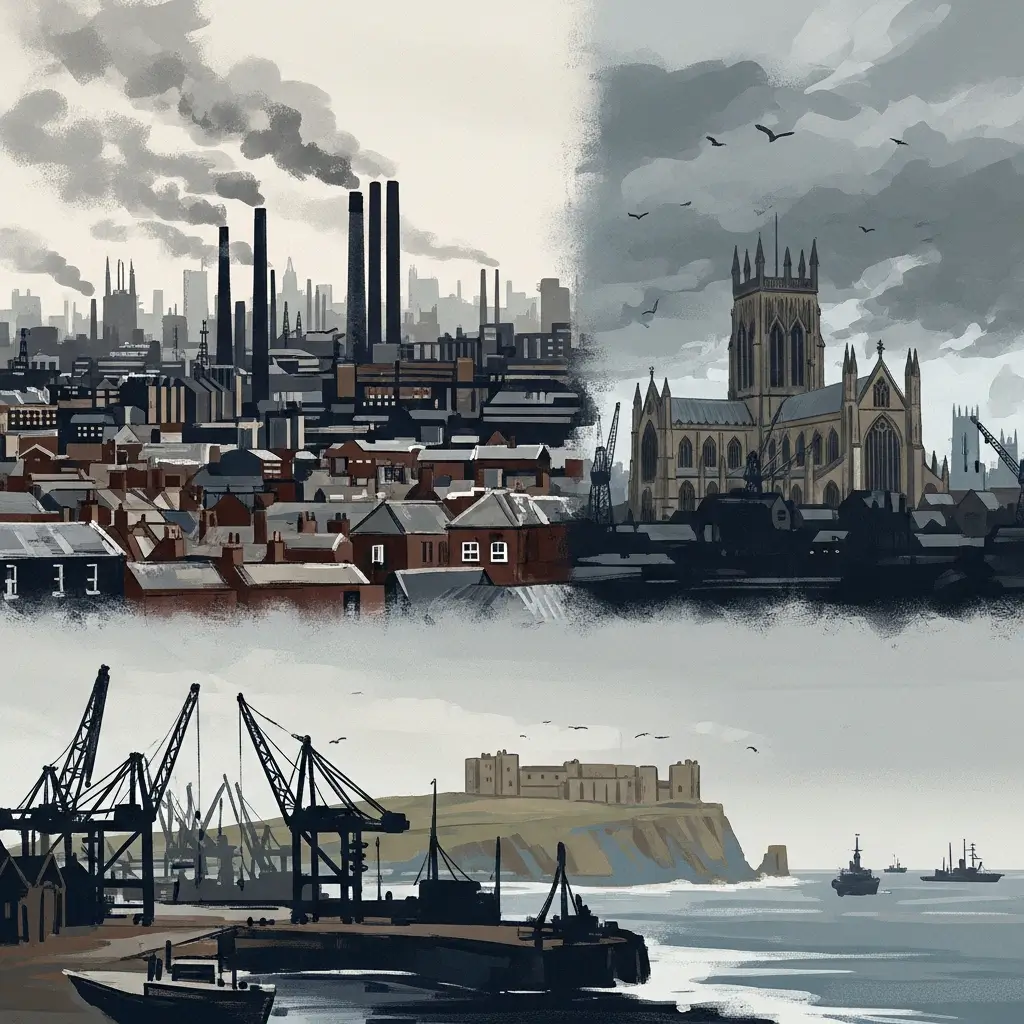
Yorkshire at War – The First World War remade Yorkshire’s urban fabric and civic life. Leeds became an “Arsenal of the North,” its Barnbow works and female workforce central to munitions output. York expanded as a military and medical hub, with depots, hospitals and training battalions.
Hull endured sustained Zepplin bombardment, civilian casualties and infrastructural loss. Scarborough suffered direct naval shelling, prompting defenses and hospital conversions. Municipal records, payrolls and press capture these shifts; further detail reveals the complex local interactions and enduring legacies.
Key Takeaways for Yorkshire at War
- Leeds became the “Arsenal of the North,” with Barnbow’s largely female workforce transforming industrial production and urban labour patterns.
- York expanded as a military hub, adding recruiting centres, training battalions, hospitals, and transport depots for the BEF.
- Hull endured sustained Zepplin attacks, suffering heavy civilian casualties, destruction, and disrupted port operations.
- Scarborough’s December 1914 naval bombardment exposed coastal vulnerability, prompting defenses and converting hotels into convalescent hospitals.
- The Home Front saw profound gendered change as women moved into munitions, nursing, and skilled industrial roles, reshaping postwar labour.
Leeds: The largest military Arsenal of the North and the Barnbow Story
Although already an industrial powerhouse, Leeds was rapidly reconfigured into what contemporaneous records and later historians term the “Arsenal of the North.”
Its engineering firms, textile mills, and forges redirected toward the urgent manufacture of munitions and military hardware; central to this change was the establishment of National Filling Factory No.1 at Barnbow, which, staffed predominantly by women, reached unparalleled production levels and became both a symbol of civilian mobilisation and the site of one of the war’s most catastrophic domestic explosions.
Archival accounts detail how Leeds’ munitions production, shell-filling factory operations, and military equipment output reshaped the wartime economy, converting industrial labour into a disciplined home front workforce of women workers, altering urban labour patterns and regional identity.
York’s Military Hub: Hospitals, Training, and Defence
While not an industrial centre like Leeds, York became an essential military hub whose infrastructures—recruiting offices, transport depots, training battalions and hospitals—were systematically expanded and repurposed to sustain the British Expeditionary Forces; archival records show the city’s rail yards and depots processed thousands of troops and vast quantities of materiel, while Purston Military Hospital, Holgate Road Auxiliary Hospital and numerous VAD-run wards absorbed waves of wounded, altering civic buildings and streetscapes into sites of military administration and care.
Records detail York’s military hospitals, the organisation of training battalions, measures against air raids, effects on the civilian population and documented community response.
Hull Under Fire: Raids, Loss, and Resilience
Hull endured sustained and concentrated attack during the First World War, its status as a major east-coast port and coal-exporting hub making it a principal target for German airship Zepplin bombardment.
Archival records document zeppelin raids, riverside fires, and concentrated wartime destruction that inflicted heavy loss and altered urban environments.
As a strategic port with crucial fishing industries and docks, Hull faced acute civilian danger yet maintained contribution to the war effort.
Contemporary reports reveal organised community response: rescue teams, shelter provision, and labour continuity.
The city’s resilience appears in rebuilding efforts and persistent maritime activity despite significant human and material costs.
Scarborough’s Shelling: A Seaside Town Besieged
From the concentrated attacks on Hull’s docks and riverside, attention shifts north along the Yorkshire coast to Scarborough, where the war reached civilian life in a different, sudden form.
Archival accounts record the German naval attack of 16 December 1914: bombardment of the castle headland, hotels, and streets that altered a seaside resort into a scarred civilian town.
Reports emphasise vulnerability, the hurried erection of coastal defenses, conversion of hotels into convalescent hospitals, and shifts toward wartime production in local yards.
Official records and local papers together trace community resilience amid damage, displacement, and national outrage.
Home Front Transformations: Women, Work, and Community Response
As wartime demands reconfigured Yorkshire’s economic and social environment, women emerged—by necessity and choice—as central agents in factories, hospitals, and civic services, a shift documented extensively in municipal records, factory payrolls, and personal correspondence.
Archival evidence from Leeds, York, Hull, and Scarborough demonstrates women’s transfer from domestic roles to skilled munitions work, nursing, tram conductorship, and administrative posts.
Local newspapers and committee minutes record community response: voluntary aid, rationing committees, and fundraising.
The Home Front thus became a contested site of labour reorganisation, civic mobilisation, and lasting gendered change, with provincial records tracing postwar labour negotiations and memory formation.
Conclusion
The Great War remade Yorkshire with pragmatic brutality: Leeds’s factories that armed soldiers also unmade familiar labour, York’s coaching inns and barracks that tended the wounded now taught a new calculus of human expendability, Hull’s blasted docks proved both strategic prize and civilian liability, and Scarborough’s promenade learned militarised fame. Ironically, the county’s avowed resilience — memorialised in rolls, hospitals and councils — testifies less to triumph than to a civilisation compelled to organise its own endurance.

FAQs About Yorkshire At War and WW1
What can I expect to see at the Yorkshire at War living history event?
At Yorkshire at War you can expect meticulous detail by respected living history groups recreating conflicts of the 20th century, from world war to more recent wars and conflicts. The event features living history displays, period camps with British Tommies and GIs, demonstrations of the land army of the Second World War, and military vehicles both on static display and in action.
Is Yorkshire at War the largest WWI and WWII vehicle and living history event in the north of England?
Yorkshire at War is promoted as one of the largest WWI and WWII vehicle and living history events in the north of England’s largest WWI/WWII gatherings, held in over 30 acres of land and drawing large crowds to witness battles, vehicle parades and re-enactments that cover the conflicts of the 20th century.
Where is the event located and is it really 10 miles north of Doncaster?
The annual Yorkshire at War event is set on a site held in over 30 acres, located roughly 10 miles north of Doncaster, north of Doncaster, making it easily accessible for visitors across the region. Specific location details and directions are available on the organiser’s site, www.yorkshirewartime.com.
Will there be WWII military vehicle displays and daily vehicle parades?
Yes — the event includes WWII military vehicle and living history presentations, with vehicles both on static display and taking part in daily vehicle parades. Visitors can witness a wide range of military vehicles, from armoured transports to support vehicles, driven and demonstrated by experienced crews.
How authentic are the re-enactments and how do respected living history groups contribute?
Re-enactments are staged with meticulous detail by respected living history groups who research uniforms, tactics and equipment to accurately represent soldiers, including British Tommies and GI units. These groups provide immersive experiences that let visitors witness battles and daily wartime life in convincing, historically informed ways.
Can families and children learn about the Army of the Second World War and the Land Army at the show?
Absolutely. The event offers educational displays about the army of the Second World War, the land army and civilian wartime roles, giving families a chance to learn how ordinary people served in the wars. Interactive exhibits and knowledgeable re-enactors make it accessible and engaging for all ages.
Does Yorkshire at War cover conflicts from the First World War through to more recent conflicts?
Yorkshire at War covers a broad span from the largest WWI battles to the Second World War and world war to more recent conflicts, offering context across decades and highlighting how warfare and society changed across the conflicts of the 20th century and beyond.
How can I find more information, buy tickets, or witness specific vehicle or living history displays?
For full event schedules, ticketing, and details on military vehicles both on static display and in parades, visit the official site at www.yorkshirewartime.com. The site lists times for daily vehicle parades, locations of living history camps, and guidance for visitors who want to witness the full scale of the event held across 30 acres of land.