
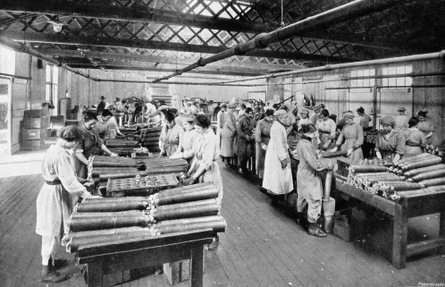
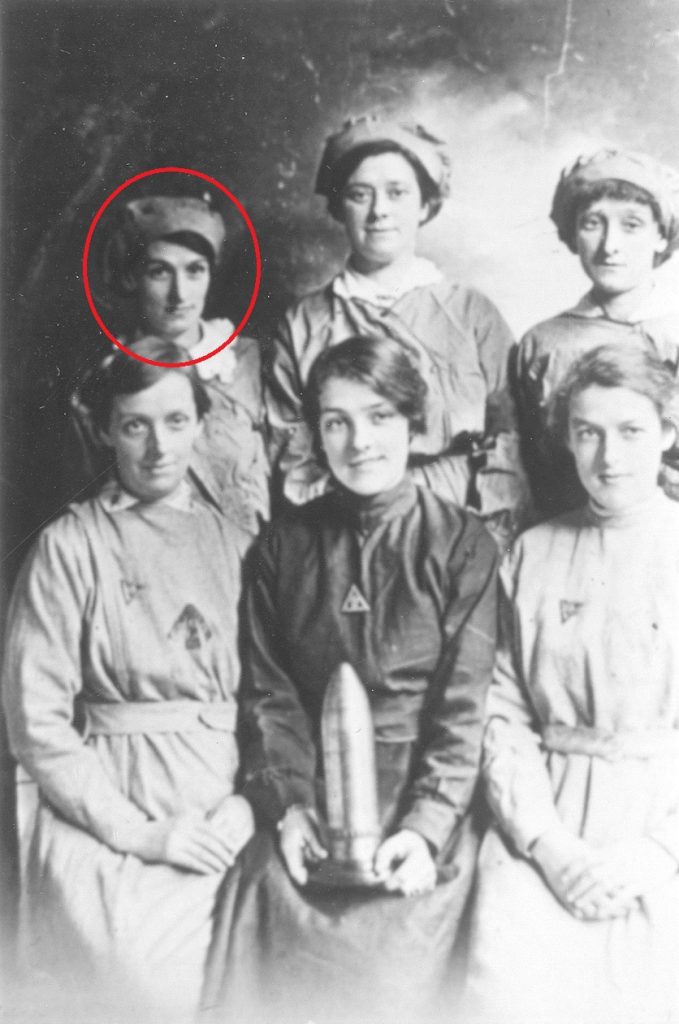
Barnbow Munitions Factory Shell-Filling Team – At the height of the First World War, the Barnbow National Filling Factory outside Leeds became one of the most important—and most dangerous—industrial sites in Britain. Thousands of women passed through its gates each day, filling artillery shells that would be fired on the Western Front. Their work was organised not around individual labour, but around a precise, unforgiving system: seven women to a bench.
This bench-gang structure defined daily life inside the factory. It shaped how women worked, how they depended on one another, and how a single error could place everyone at risk.
Key Takeaways
- Barnbow bench gangs of seven women each performed single, specialized tasks to fill artillery shells rapidly and safely.
- Roles included shell carrier, filler, cooling operator, presser/leveler, and wiper/inspector, with others supporting workflow.
- Charge hands led teams, enforced safety, balanced quotas, and mediated between management and workers.
- Informal safety culture and peer vigilance mitigated risks created by fatigue and bonus-driven production pressure.
- Intense repetition, night shifts, and shared responsibility created strong comradeship alongside constant emotional strain.
Barnbow Munitions Factory: Context and Scale
Barnbow opened in 1915 as part of the Ministry of Munitions’ rapid wartime expansion. Located east of Leeds, it grew at extraordinary speed. By 1916, the factory employed around 16,000 workers, the majority of them women, many drawn from Leeds, York, Castleford, and surrounding towns.
The factory ran around the clock. Night shifts commonly began at 10:00 pm and ran until early morning. Inside the filling rooms, work was broken down into tightly controlled systems designed to maximise output while handling highly volatile explosives such as TNT and amatol.
Each filling room was divided into multiple bench gangs. These small units were the core of production—and the core of risk.

The Seven-Woman Bench Gang System
Shell filling at Barnbow was not an individual task. It was a coordinated sequence of actions carried out by seven women, each assigned a specific role. The system was designed to keep shells moving continuously along the bench, minimising delays and unnecessary handling.
The logic was simple: if every woman performed her task correctly and in time, production flowed smoothly. If one step failed, the entire process faltered.
Speed mattered, but coordination mattered more.
Roles Within a Barnbow Shell-Filling Team
Each bench gang followed the same basic structure, with clearly defined responsibilities.
Shell Handling and Preparation
The process began with the handling of empty shell casings. Even before explosives were introduced, the work was physically demanding. Casings were heavy, awkward, and cold to the touch. Fatigue often began here, long before the most dangerous stages of the process.
Filling with TNT or Amatol
The filler’s role was one of the most hazardous. Molten explosive—either TNT or amatol—was poured into the shell casing. The substance gave off fumes, stained skin yellow, and could cause chronic illness with prolonged exposure.
Precision was critical. Overfilling increased pressure inside the shell and raised the risk of ignition during later stages. Underfilling disrupted production and triggered inspections.
Cooling and Settling
Once filled, the shell had to cool and settle. This stage required patience and timing. Too rapid a progression risked cracks or instability; too slow a pace slowed the entire bench.
Pressing and Levelling
After cooling, the explosive was pressed to the correct depth, creating space for the gaine and fuse assembly. Even small inaccuracies at this stage could introduce dangerous stresses into the shell.
Cleaning and Wiping
Shell wiping was often underestimated, but it was a crucial safety step. Residue, grit, or explosive dust left on the casing increased the risk of friction or sparks during capping. The wiper also performed a final visual check, often catching defects others missed.
Preparation for Capping
Before the shell could be sealed, threads had to be clean and properly aligned. Cross-threading or misalignment could cause catastrophic friction when the cap was inserted.
The Charge Hand
Overseeing the entire bench was the charge hand. She was responsible for output, discipline, and safety, and reported to higher-level watchers and inspectors. Charge hands were under intense pressure, balancing production targets against the very real dangers facing their teams.
Rhythm, Reliance, and Repetition
A well-functioning bench gang could complete roughly one shell per minute. Tasks overlapped continuously, creating a relentless rhythm. There were no natural pauses once production began.
Repetition was constant. The same motions were performed hundreds of times per shift, often under artificial light and heavy heat. Over time, fatigue dulled concentration and slowed reaction times—especially on night shifts.
Each woman relied on the precision of the others. No task stood alone.
How One Mistake Could Affect Everyone
The danger at Barnbow was cumulative. A slightly overfilled shell might survive one stage only to fail at another. Residue left during cleaning could become deadly during capping. A misaligned thread could generate enough friction to ignite the explosive inside.
When something went wrong, responsibility did not fall on a single pair of hands. Every woman at the bench shared the risk—and, in the event of an explosion, the consequences.
Teamwork Over Speed
Although speed was encouraged, especially after bonus schemes were introduced in 1916, survival depended on cooperation. Informal safety practices developed among the women: watching each other’s hands, issuing quiet warnings, correcting small mistakes before they escalated.
Speaking up could slow production and attract scrutiny, but silence could be fatal. Trust became a form of protection.
Trust Under Extreme Conditions
Many women worked alongside neighbours, relatives, or friends they travelled with on factory trains. Shared routines, exhaustion, and danger forged bonds that went beyond the bench.
At the same time, risk became normalised. Constant exposure to danger, combined with the need to earn wages for families already strained by war, dulled fear and encouraged women to push themselves beyond safe limits.
Room 42 and the Cost of Failure
On the night of 5 December 1916, an explosion tore through Room 42 at Barnbow at 10:27 pm. Thirty-five women were killed. The official cause was never publicly detailed. Death certificates recorded the event simply as “death by accident.”

Fatigue, production pressure, and the cumulative effects of minor errors are widely understood to have played a role.
A Story Grounded in Structure
A Penny a Shell follows one such seven-woman bench gang during the final minutes of a night shift. While the characters are fictional, the structure, rhythm, and risks they face are rooted in the documented reality of Barnbow’s shell-filling teams.

Understanding how seven women worked as one helps explain not only how munitions were made, but why the cost of failure was so devastating—and so often borne in silence.
Frequently Asked Questions
What was the Barnbow shell filling factory during World War One?
The shell filling factory at Barnbow was part of a vast factory complex established during World War One to supply high-explosive artillery shells to the British Army. Operating as a government-run royal ordnance factory, the factory at Barnbow played a crucial role in Britain’s wartime munitions output between 1915 and 1918.
Who worked at the shell factory at Barnbow?
The work force at the Barnbow shell factory consisted mainly of women, supported by a smaller number of male supervisors and technicians. These factory workers came from Leeds and surrounding areas, many recruited from industries such as the Leeds Forge Company, which helped train staff and supply equipment during the war.
How was the Barnbow factory complex organised?
The Barnbow factory complex was divided into multiple factory buildings, each assigned specific tasks such as filling, cooling, inspection, and storage. Within the shell-filling rooms, women worked in tightly coordinated teams at shared benches to maintain speed, safety, and continuous output.
What happened on 5th December 1916 at Barnbow?
On 5th December 1916, an explosion occurred in Room 42 of the shell filling factory, killing 35 women. Although the official explanation was limited, the incident became one of the deadliest industrial accidents in British history during World War One.
Why were women employed in dangerous factory work during 1917 and 1918?
By 1917, labour shortages caused by military enlistment meant women were essential to the munitions industry. Despite the risks, factory wages were often higher than domestic service or textile work, making employment at a shell factory a financial necessity for many families through 1918.
What facilities were available to factory workers at Barnbow?
Barnbow included support facilities such as a canteen, where workers were encouraged to drink milk and eat during breaks, based on the belief that it helped counteract the effects of TNT exposure. These spaces also offered rare moments of rest during long, exhausting shifts.
Who were the men working at Barnbow?
While women formed the majority of the workforce, three men are known to have been killed alongside the women in the 1916 explosion. Men typically worked as inspectors, supervisors, or engineers within the royal ordnance factory, overseeing machinery and safety procedures.
Is there a roll of honour for the Barnbow workers?
Yes, a roll of honour exists to commemorate those who lost their lives at the factory, particularly following the events of 5th December 1916. For many years, these names were largely absent from public memorials, reflecting how industrial wartime deaths were often overlooked.
What happened to the Barnbow shell factory after the war?
Following the end of World War One, the factory at Barnbow gradually reduced operations and closed as wartime demand ended. Like many royal ordnance factories, its buildings were dismantled or repurposed, leaving little visible trace of the enormous workforce that once laboured there.