

The munitions factory at Barnbow became one of the most intense industrial environments of the First World War. Urgent Army demand transformed a quiet Yorkshire plant into a relentless shell-making operation where thousands of women carried out cleaning, filling, weighing and inspection work under hazardous conditions and gruelling shifts.
Production pressure, fatigue and chemical exposure shaped every task. High quotas and wartime urgency created an environment where safety precautions could reduce—but never fully eliminate—the catastrophic risks inherent in handling explosives. These pressures influenced factory layouts, procedures, and the long-term memory of the Barnbow workforce in Britain’s wartime history.
Key Takeaways
- Women staffed cleaning, filling, weighing and inspection roles that kept Barnbow’s high-output production running during WWI.
- Long shifts, chemical exposure and strict quotas heightened fatigue and human-error risks.
- Safety features such as segregated sheds, blast walls and inspection procedures reduced hazards but could not prevent major accidents.
- The Ministry of Munitions prioritised output through standardised processes and tight oversight, limiting local discretion.
- The Barnbow tragedy revealed the human cost of wartime manufacturing, influencing later engineering reforms, automation, and factory design.
How Armed Forces Demand Shaped Work at Barnbow
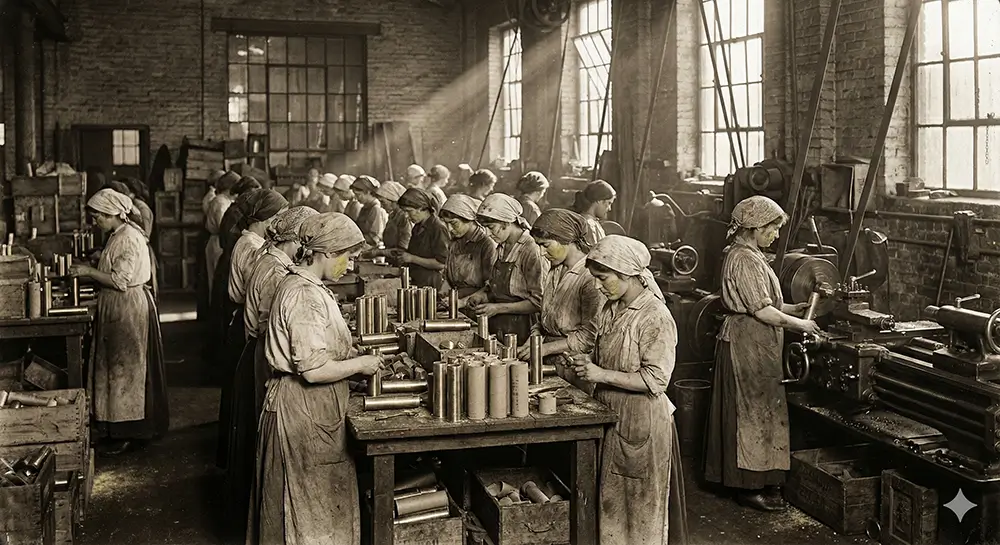
The Army’s insatiable need for shells turned Barnbow into an unyielding production line. Every shift moved through a tightly controlled sequence—cleaning, molten TNT pouring, measuring, fitting the gaine and conducting final inspections. Each stage carried its own hazards.

TNT, cordite and related vapours made the air itself a risk. Dust clung to hair and clothing, friction could spark ignition, and the long, repetitive shifts common in wartime manufacturing intensified fatigue-related mistakes. The Ministry of Munitions and Royal Ordnance introduced strict procedures and quotas, yet the pace of production often prioritised speed over caution.
What Tasks Defined the Filling Factory—and Why Were They Dangerous?
Barnbow’s filling sheds functioned as a near-military system. Teams of women progressed through precise, high-stakes steps that transformed raw steel into live ordnance:
- Cleaning and preparing shell cases
- Pouring or pressing explosive
- Weighing and adjusting charges
- Fitting the gaine
- Wiping dust and residue
- Screwing on caps
- Conducting final inspection
Each stage reflected both wartime urgency and significant danger. TNT dust, overfilling, chemical exposure and mechanical friction created conditions in which a single mistake could cascade through a crowded room. Discipline and speed became inseparable from risk.
How Explosives and Chemical Exposure Increased Hazards
TNT, propellant and pyrotechnic compounds amplified risks far beyond typical industrial work. Women handled molten charges, fitted gaines and cleaned residue in environments where vapours, dust and static electricity were omnipresent.
Safety measures existed, but fatigue, high output expectations and repetitive tasks meant that risk remained constant. Barnbow’s workforce operated at the intersection of military demand and civilian labour, bearing the human cost of an industrial war.
Ministry of Munitions and Royal Ordnance: Their Influence on Safety
Although driven by wartime necessity, the Ministry of Munitions and Royal Ordnance shaped daily routines at Barnbow through centralised procedures and quota enforcement. Uniform processes standardised production and limited improvisation, reducing some accidents while intensifying pressure on workers.
Inspectors oversaw consistency, quality and adherence to safety rules. Local factory management had little discretion to alter systems that were designed primarily to maintain output for the Western Front.
Safety Measures Introduced by Wartime Authorities
Authorities and engineers introduced multiple safety features to reduce accident frequency and minimise the damage when incidents occurred:
- Segregated filling sheds
- Blast walls and earth banking
- Improved ventilation
- Non-sparking tools and footwear
- Stricter inspection routines
- Formalised training and shift limits
These reforms reflected a growing recognition of the risks involved, though they still could not prevent catastrophes like the 1916 explosion in Room 42.
Changing Ordnance Factory Design to Prevent Explosions
Explosions across Britain’s wartime filling factories prompted rapid redesign. New layouts separated high-risk filling zones from lower-risk assembly areas. Buildings were spaced further apart, blast walls became standard, and ventilation systems reduced dangerous vapours.
Design changes sought to reduce the likelihood of chain reactions and to protect workers when accidents did occur.
The Ministry of Defence and Later Safety Reforms
As public awareness of industrial wartime casualties grew, the Ministry of Munitions (and later defence authorities) moved toward a more active regulatory role. Reviews emphasised compartmentalisation, improved plant layouts, and stricter handling protocols.
Funding for modernisation led to feasibility studies for future ordnance sites, establishing the groundwork for automated, safer munitions production in the decades after the war.
Feasibility Studies and “Factories of the Future”
Technical assessments conducted after the First World War helped convert painful lessons into modern engineering standards. Recommendations typically included:
- Blast-proof barriers and compartmentalised cells
- Automated or remote filling systems
- Continuous contamination monitoring
- Dust extraction and controlled ventilation
- Fatigue-management protocols
- Advanced PPE and training requirements
These proposals continue to influence contemporary munitions factory design.
Why Women Worked in Barnbow and Other UK Filling Factories
With men mobilised for the front, women became essential to Britain’s armament production. New factories—particularly on Teesside—created thousands of roles requiring manual precision, chemical awareness, steady nerves and the stamina needed for continuous production.
Women became the backbone of the home-front supply chain, sustaining an industrial war effort that depended on their skill and discipline.
Skills Required for Propellant, Pyrotechnics and Explosives Work
Effective work with energetics demanded:
- Fine manual dexterity
- Absolute adherence to procedure
- Basic chemical understanding
- Physical stamina
- Calmness under pressure
These competencies enabled recruits with no prior industrial experience to perform highly dangerous and technically demanding wartime tasks.
Comparing Hazards Across Different Filling and Explosives Factories
Accidents at Barnbow were part of a wider pattern across Britain’s wartime manufacturing sector. Facilities at Grangemouth and Milford revealed additional failure modes—ventilation issues, vapour build-up, mechanical shock, and inadequate inspection regimes.
Differences in chemical composition shaped accident profiles:
- TNT: friction-sensitive dust, risk of sudden detonation
- Propellant: decomposition fires and smouldering incidents
- Pyrotechnics: frequent small ignitions and toxic fumes
Safety systems were increasingly customised to the material in use.
What Was Learned From Grangemouth, Milford and Other Incidents?
Investigations into these sites identified common factors: rushed production, insufficient ventilation, complacency, and worker fatigue. Reforms emphasised:
- Separation of production stages
- Mandatory rest breaks and rotation
- Improved ventilation
- Transparent reporting and independent inspections
These standards became part of the evolving safety culture of munitions work.
Composition of Munitions and Accident Patterns
Mapping accidents onto the types of explosives used revealed predictable patterns. TNT’s friction sensitivity made shell-filling rooms especially vulnerable to catastrophic events. Propellant plants faced decomposition fires, while pyrotechnic operations dealt with localised ignitions.
Understanding these patterns helped shape later regulations and engineering practices.
Support and Recognition for Surviving Workers
After the war, support for surviving workers was limited. Some received small pensions, medical referrals or gratuities, but large-scale compensation was rare. National memorials focused on front-line casualties, leaving women in munitions factories largely absent from formal remembrance.
Local communities eventually spearheaded plaques and ceremonies that preserved the memory of workers like the Barnbow Lasses.
Efforts at Compensation and Memorialisation
Official responses from the Ministry of Munitions and Royal Ordnance were modest, often framed by wartime budgets and administrative constraints. While some individual claims were supported, broader recognition remained sparse. Community-driven memorials became the primary means of honouring the women who died.
Public Memory of Munitions Workers in the UK
National narratives of the First World War long prioritised soldiers’ sacrifice over the hazardous labour of women in wartime industry. Barnbow’s story remained peripheral for decades, despite the scale of its human loss.
Only recent historical work and local advocacy have integrated these women into Britain’s wider remembrance culture.
Could Modern Munitions Factories Prevent Another Barnbow?
Today’s engineering standards—automated filling lines, inert systems, controlled ventilation, fatigue monitoring and distributed multi-site production—aim to eliminate the conditions that made disaster possible in 1916.
Modern feasibility studies emphasise risk dispersion, community safety, and redundancy in production systems, reflecting lessons from historic failures such as Barnbow.
Factories of the Future and Explosive Risk Reduction
Future-oriented designs focus on:
- Sealed, automated filling systems
- Distributed small-batch production
- Real-time environmental monitoring
- Redundant containment and blast zoning
These innovations treat worker safety as mission-critical rather than secondary to output.
Defence Planning and the Siting of New Ordnance Facilities
Contemporary defence planning proposes a network of dispersed ordnance sites across the UK. Feasibility studies evaluate risk, logistics, workforce availability and community impact to prevent single points of catastrophic failure and ensure resilient wartime supply.
Lessons for Modern Decision-Makers
Historical case studies such as Barnbow continue to inform decisions made by officials including John Healey. Key lessons include:
- Prioritising dispersed production across multiple sites
- Automating hazardous tasks
- Locating factories safely away from dense communities
- Embedding local emergency planning into operation
These principles ensure that advances in production capacity never override worker safety.
Conclusion
Barnbow represents a forgotten frontline of the First World War: women whose hands fed the Western Front and whose sacrifices remained largely unspoken for decades. The explosion in Room 42 forced changes in engineering standards, training, safety culture and public recognition.
Its legacy endures in how Britain designs, regulates and remembers its munitions industry—a reminder that industrial warfare reshapes not only battlefields but also the factories, workers and communities that sustain them.