
You’re looking at a secret wartime munitions town where mostly women worked around the clock, under harsh quotas and poisonous dust. On 5 December 1916 an explosion in Room 42 killed dozens and injured many more; workers resumed under shock to prevent greater danger.
Government censorship buried details and stifled grieving, so the true scale was hidden for decades. Keep going and you’ll uncover the human cost, the cover-up, and how memory was finally restored.
Key Takeaways on the Barnbow Munitions Factory
- On 5 December 1916 at 10:27 pm, a catastrophic explosion occurred in Room 42 of the Barnbow munitions factory, killing 35 workers instantly.
- The factory, run largely by women (“barnbow lasses”), produced shells under intense quotas and long shifts that compromised safety.
- The explosion happened during the final shell-assembly stage, likely caused by contamination, dust, or procedural pressure.
- Wartime censorship and terse death notices suppressed public awareness, obscuring the disaster for decades.
- Local research from the 1960s onward led to memorials and renewed recognition of the victims and unsafe wartime working conditions.
Barnbow National Filling Factory no.1: A Factory the Size of a Small Town
When you walked onto the Barnbow site during the First World War, you were stepping into an industrial town designed solely to feed the front: 16,000 workers, almost all women, worked around the clock in dozens of purpose-built huts, with the factory running its own railway, hospital, canteen currency and farm to keep production moving.
You’d see the national filling factory’s scale: shell filling lines, yards of conveyor belts and disciplined teams. In Leeds this became synonymous with munitions production and intense working conditions: long shifts, strict clothing rules, and constant pressure to meet quotas.
You’d also sense risk — Room 42’s explosion exposed the lethal reality behind output figures.
Today Barnbow stands as industrial memory and a site of remembrance.
Life and Labour: The Women Who Kept the Guns Firing
Although they’d never held a rifle, the thousands of women at Barnbow kept the guns firing through unyielding, skilled labour that demanded steadiness, secrecy and speed.
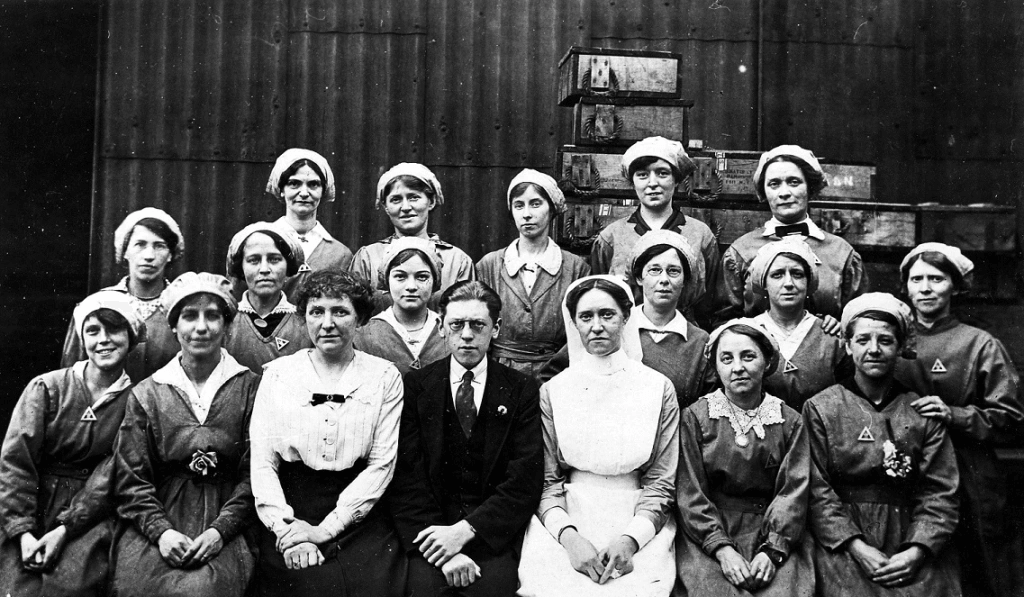
You see how barnbow lasses and other women workers formed the backbone of National Filling Factory No.1, the shell filling factory that sustained front-line artillery.
You know the risks: toxic dust, strict silence, piecework pressure and gruelling shifts.
After the explosion of December 1916 many lost their lives, yet the workforce kept production moving.
You should recognise their courage and the harsh working conditions that defined munitions factory life.
Their memory now sits in a local war memorial, a corrective to wartime silence and institutional forgetfulness.
- Skilled, disciplined teams
- Dangerous, repetitive tasks
- Community sacrifice and remembrance
Room 42: The Night of the Explosion
If you step into the story of Room 42 on the night of 5 December 1916, you’ll find a place where routine and risk collided with catastrophic speed: teams of women worked in strict silence on the last, most hazardous stage of shell assembly, pressured by quotas and bonuses, and at 10:27 pm a single, devastating explosion wiped out a bench of workers, blew out walls and left a crater where the room had been, killing thirty-five outright and injuring many more.
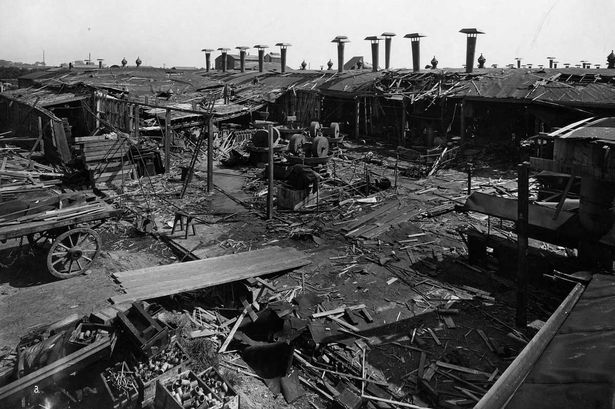
You see Barnbow’s munitions factory as a tightly run machine where production pressure stretched safety procedures to breaking point. The blast in Room 42 produced immediate casualties, horrific damage and shocked survivors who resumed work to avoid further danger.
Wartime censorship muted public reckoning.
Secrecy and Silence: Wartime Censorship and Its Toll
Because the government moved quickly to control information, you won’t find Barnbow in contemporary headlines—only a clipped Ministry bulletin that buried the truth and silenced grieving families.
You confront deliberate wartime censorship: the national shell filling factory’s location and scale were omitted, death notices were terse telegrams, and the silence that followed erased public reckoning.
You learn that at the Barnbow munitions factory women workers were killed in the explosion, yet the press printed only guarded phrases to protect morale and production.
That secrecy shaped memory and delayed justice.
Remember these consequences:
- Hidden costs of war: unacknowledged loss among factory workers and families
- Official suppression: constrained reporting, censored names, muted grief
- Long-term toll: delayed memorials and fragmented community healing
Remembering Barnbow: Memorials, National Heritage Rediscovery, and Legacy
When local historians and relatives began to piece the story back together in the 1960s and 1970s, they forced a long-overdue reckoning with Barnbow’s hidden toll.
You’ll see rediscovery drive memorials: plaques, the Manston Park monument, and panels that name the women and girls lost in the 1916 explosion.
You should treat these markers as corrective history and as prompts to reassess safety protocols then and now.
Barnbow’s legacy is twofold: it records wartime sacrifice and warns about industrial danger under production pressure.
By situating Barnbow within national heritage, you acknowledge previously silenced labour, press censorship, and community grief.
Visit, study, and teach this site so the lessons inform memorial practice, safety standards, and public memory.
Conclusion on the Barnbow Canaries
You stand where industry once hummed and realize the “home front” meant danger, not comfort. Women as young as fourteen kept shells feeding the war machine, yet their sacrifice was hushed by secrecy and class. Ironically, the country that praised bravery buried their names to protect morale. Now you’re left to reclaim the truth: to remember Barnbow’s thirty-five and honor the countless quiet labors the official record chose to forget.
About Antony J bell Author
Antony J. Bell is a historical fiction author whose work is deeply rooted in the history and soil of the North of England. Raised in a working-class Yorkshire family, he has always been drawn to the quiet, untold stories of ordinary people caught in the sweep of extraordinary events.

His debut novel, A Penny a Shell, is a personal tribute born from a piece of his own family history: the story of his great-grandmother, who was one of the thirty-five women killed in the catastrophic Barnbow munitions factory explosion of 1916.
FAQs About The Barnbow Factory and Disaster
What was the Barnbow explosion?
The Barnbow explosion was a massive blast at the National Filling Factory No.1 in Leeds on 5 December 1916, killing 35 women and girls working the night shift in Room 42 of the shell-filling sheds. It remains one of the worst industrial disasters in Yorkshire during the First World War.
Where was the National Filling Factory No.1 located?
The factory stood between Cross Gates, Manston, and Garforth in East Leeds, on land off Barnbow Lane. The site was sometimes called the Barnbow Munitions Factory, the shell filling factory, or simply “Barnbow.”
Why was Barnbow important during the First World War?
Barnbow was one of Britain’s most productive filling factories, employing over 4,000 munitions workers. It supplied 4.5-inch shells, 6-inch shells, and 18-pounder shells to the Army Ordnance Department at a critical stage of the Great War.
Who were the Barnbow Lasses?
The Barnbow Lasses were the thousands of women and girls who worked at the shell factory between 1914 and 1918. Many became known as Barnbow Canaries, a nickname for munitions workers whose skin turned yellow from handling explosive materials like TNT and cordite.
What caused the explosion in Room 42?
The exact cause has never been proven. Most theories point to a faulty shell, an overfilled TNT charge, or accidental ignition of explosive residue. The Ministry of Munitions conducted a private investigation, but wartime secrecy prevented details from being published.
How many women were killed in the Barnbow disaster?
A total of 35 factory workers—all women and girls—lost their lives in Room 42 on Tuesday, 5 December 1916. Many were from Leeds, West Yorkshire, and nearby towns such as Harrogate, Armley, and Crossgates.
Why wasn’t the Barnbow explosion reported in the newspapers?
Due to wartime censorship, every death notice was recorded simply as “death by accident.” The Yorkshire Evening Post and other papers printed a short statement from the War Press Bureau but did not name Barnbow or mention the scale of the disaster.
What was life like working at Barnbow?
Shifts were long, often overnight, and involved dangerous shell filling operations with highly unstable materials. Workers changed into protective overalls in the factory canteen, travelled via the Barnbow Halt railway, and earned higher wages than most civilian jobs in Leeds City.
What were the “Barnbow Specials”?
“Barnbow Specials” was the name given to the trains that carried thousands of workers to the factory complex each day. During peak production, the factory consumed up to 300 gallons of milk daily for women suffering from TNT poisoning.
What happened at Barnbow before and after the explosion?
The factory opened in December 1915 after the declaration of war with Germany, and by October 1916 it had become Britain’s most productive national filling factory. Filling operations continued until after the end of the war in November 1918, with Barnbow helping clear surplus war materials.
What is on the Barnbow site today?
Much of the original factory buildings, filling sheds, and the factory complex are gone, but the site is recognised for its national heritage importance. A war memorial stands in Manston Park and the Roll of Honour lists the 35 women who were killed.
Was Barnbow really the first National Filling Factory?
Yes. National Filling Factory No.1, known as Barnbow, was Britain’s first national shell filling factory. It was built rapidly between August and December 1915 and operated continuously until 1924.
What did a typical shift involve for munitions workers?
Workers handled shell filling, weighing, fuse fitting, and cleaning operations. The most dangerous work—done in Room 42—involved assembling explosive shells under strict silence. Despite the risks, many women were proud to support the war effort.
Were there other accidents at Barnbow?
Yes. Explosions also occurred in March 1917 and May 1918, killing additional workers. However, the 5th December 1916 disaster remains the deadliest.
Is Barnbow recognised today?
Yes. The site is now acknowledged as part of Britain’s national heritage, with plaques, research projects, and annual acts of remembrance preserving the story of the women workers who were killed.