
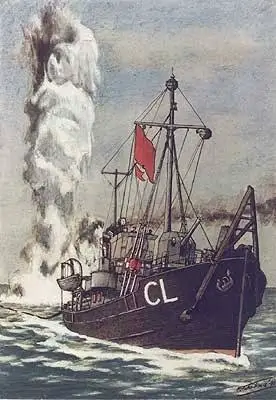
How a WW1 trawler swept for mines In the first winter of the First World War, the most dangerous weapon in the North Sea could not be seen. It sat a few feet under the water, waiting for a hull to touch it.
The job of finding it fell to fishermen.
The hidden enemy
The German mines of 1914 were moored contact mines: iron spheres packed with around 350 pounds of explosive, studded with lead-covered horns. If a ship’s hull struck a horn hard enough to crack it, the mine fired.
Each mine was anchored to a heavy sinker on the seabed by a mooring cable, set so that the mine floated just below the surface: deep enough to be invisible, shallow enough to catch a passing ship. From the deck of a trawler, a minefield looked like nothing at all. Just grey water.
Ships could not steer around what they could not see. The only answer was to drag the sea and pull the mines up.
Why fishing trawlers?
The Royal Navy went to war with very few minesweepers. What it did have was the largest fishing fleet in the world.
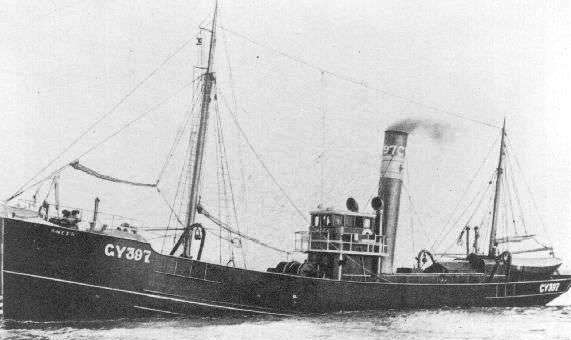
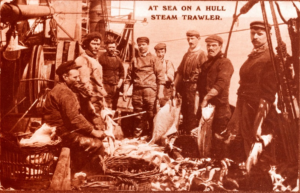
Steam trawlers were almost perfect for the job. They were tough, built for bad weather, and already fitted with powerful steam winches and heavy steel wire for hauling a trawl. Their crews knew the North Sea better than any naval officer, and they were used to hard, dangerous work in the cold.
So the Admiralty hired them. Trawlers were taken into service with their skippers and crews, who were enlisted in the Royal Naval Reserve‘s Trawler Section, given a gun, a White Ensign and very little training, and sent out to sweep. By the end of the war the minesweeping force had grown to more than a thousand vessels. The rest of the Navy, half amused and half admiring, called it “Harry Tate’s Navy”.
The two-boat sweep
The basic method was simple. Two WW1 trawler steamed side by side, a few hundred yards apart, with a long steel wire slung between their sterns. The wire hung in a deep curve under the water, reaching down to the depth where the mines’ mooring cables were.
To keep the wire down, each boat towed a kite. This was not a kite in the usual sense, but a heavy wooden frame that dived as it was pulled through the water, in the same way an ordinary kite climbs into the wind. The kite dragged its end of the wire down and held it at depth.
On each boat, the wire ran out from the steam winch. That made the man on the winch brake one of the most important men aboard. As the boats rose and fell on the swell, the strain on the wire surged and slackened. Too much brake and the wire could snap or foul; too little and the sweep sagged and went slack. A good winchman read the sea through the vibration in the brake lever and fed the wire out or held it as the stern lifted and dropped.
It was exhausting, freezing, constant work, hour after hour, often in the dark.
Catching a mine
As the two WW1 trawler steamed forward, the wire swept through the water like a fishing line, and sooner or later it caught a mine’s mooring cable.
What happened next depended on luck and skill. Often the strain of the sweep simply parted the mooring, or the trawlers dragged the mine and its sinker along the bottom until the cable broke. Sometimes they towed the catch into shallower water before freeing it. Later in the war, from 1916, the Admiralty introduced a serrated sweep wire with one rough strand that sawed through a mooring cable as it dragged across it.
Once the mooring was gone, the mine was free, and it bobbed to the surface.
Sinking it
A loose mine on the surface was still deadly, to the sweepers themselves and to anything that came along afterwards. It had to be destroyed.
The usual method was rifle fire. Men stood at the rail and fired at the floating mine from a safe distance. A bullet through the casing let the sea in and sank it. A shot that struck a horn could set it off, throwing up a great column of water. Trawlers also carried a small deck gun, often a 6-pounder, which could be used on a mine that rifles could not finish.
Then they went back to sweeping, and waited for the next one.
The cost
The work was brutal, and the losses were heavy. The sweepers had to steam through water that had not yet been cleared, so every boat was exposed, all the time. A mine could go off in the sweep, or the trawler could run straight over one the wire had missed.
In the first two months of the war, roughly one trawler was lost for every five mines swept. Over the whole war, 214 minesweepers were sunk, an average of about one a week. When the war ended, there were still tens of thousands of mines in the sea to clear.
The minefield off Scarborough
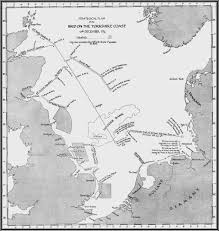
The people of Scarborough saw the danger at first hand. During the German raid of 16 December 1914, the cruiser Kolberg laid a large minefield off the Yorkshire coast near Flamborough Head, the densest field of mines yet laid in naval warfare.
Trawlers arrived to sweep it within days. On Christmas Day 1914, the minesweeping trawler Night Hawk struck a mine a few miles off Scarborough and sank in seconds; six of her crew were killed. Merchant ships were sunk in the same field. A safe channel was open by Boxing Day, but the minefield was not fully cleared until April 1915, and other trawlers were lost in the work.
In the novel
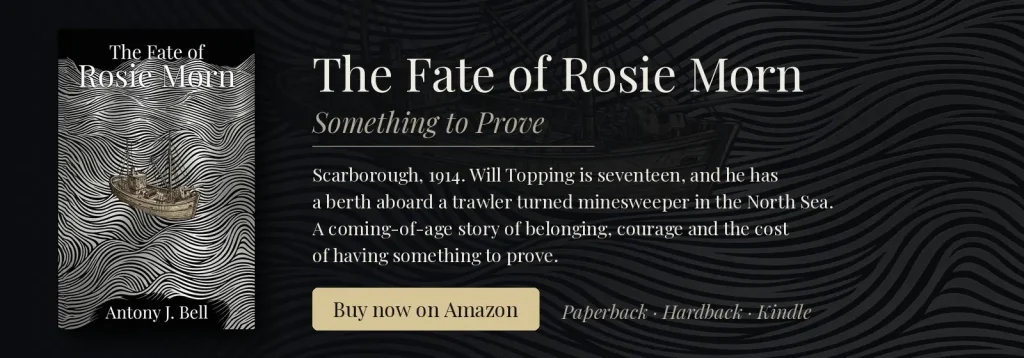
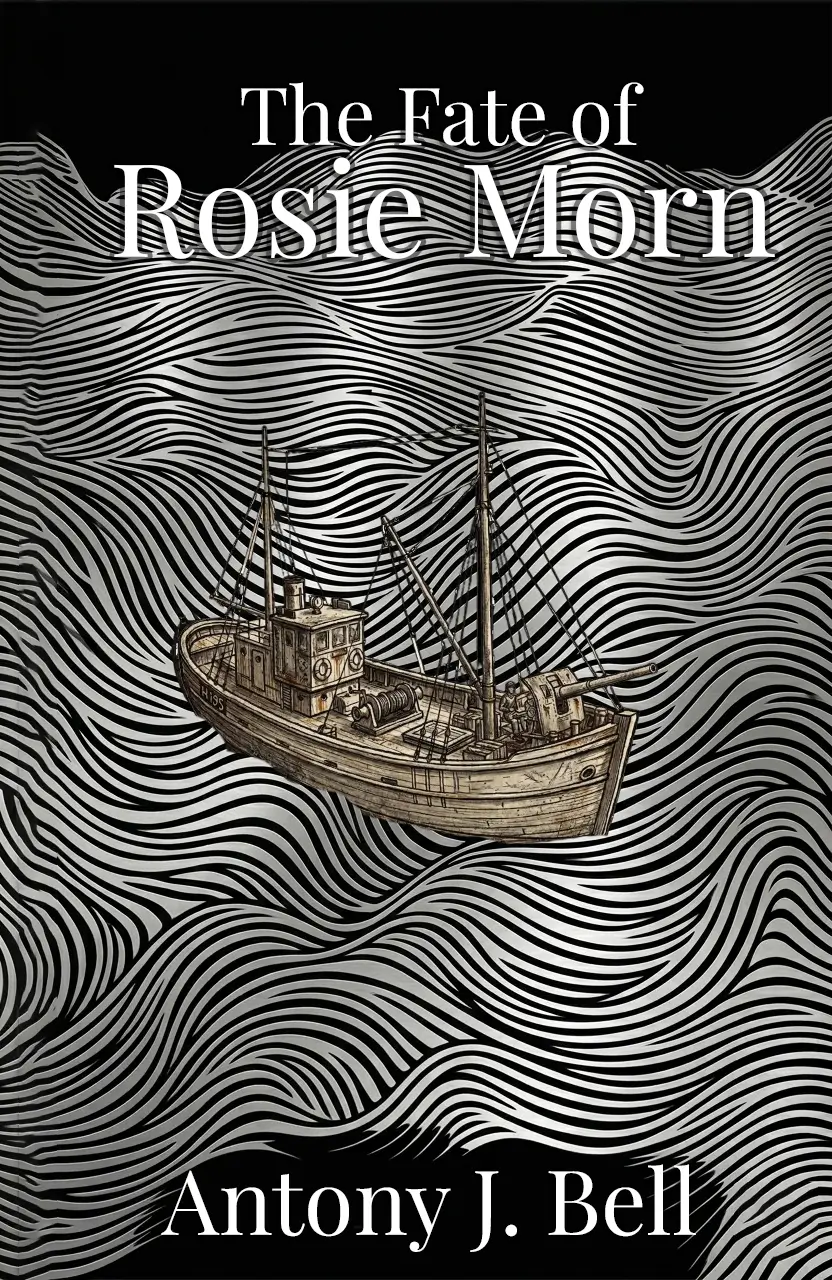
In The Fate of Rosie Morn, seventeen-year-old Will Topping is given the job of winch hand: the man on the brake, holding the sweep wire steady while the sea tries to tear it out of his hands. Everything in the book comes back to that lever, and to the crew of fishermen around him doing a naval job they were never trained for, in the same waters, in the same winter.
Read the novel
The Fate of Rosie Morn follows Will aboard a Scarborough trawler turned minesweeper in the winter of 1914–15: a coming-of-age story about belonging, courage and the cost of having something to prove. Released 1st November 2026.