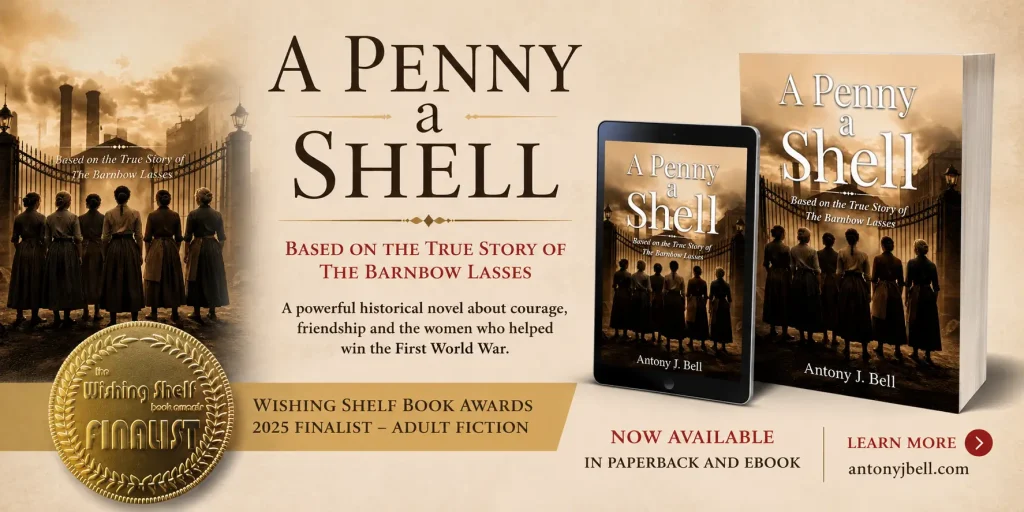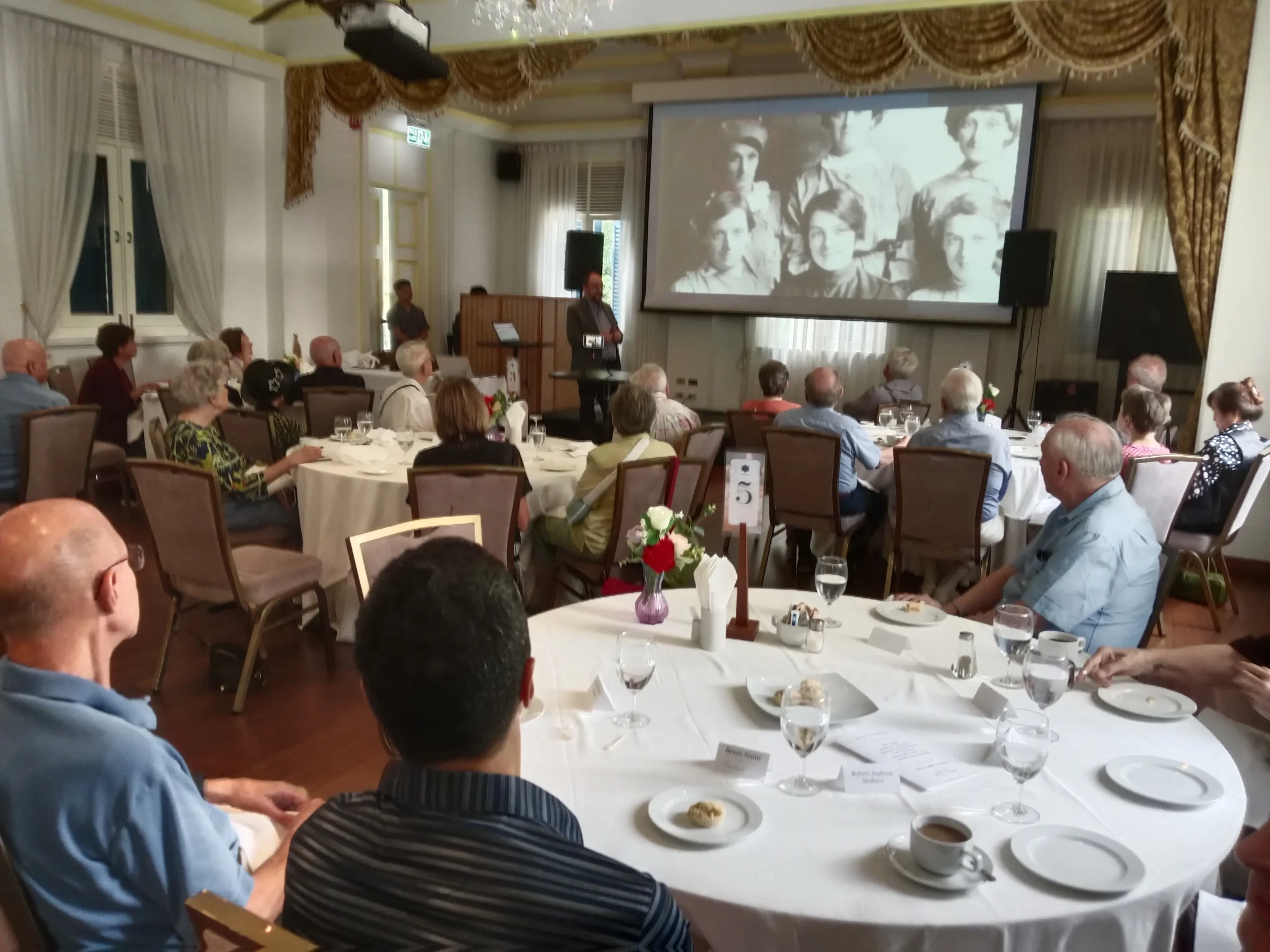

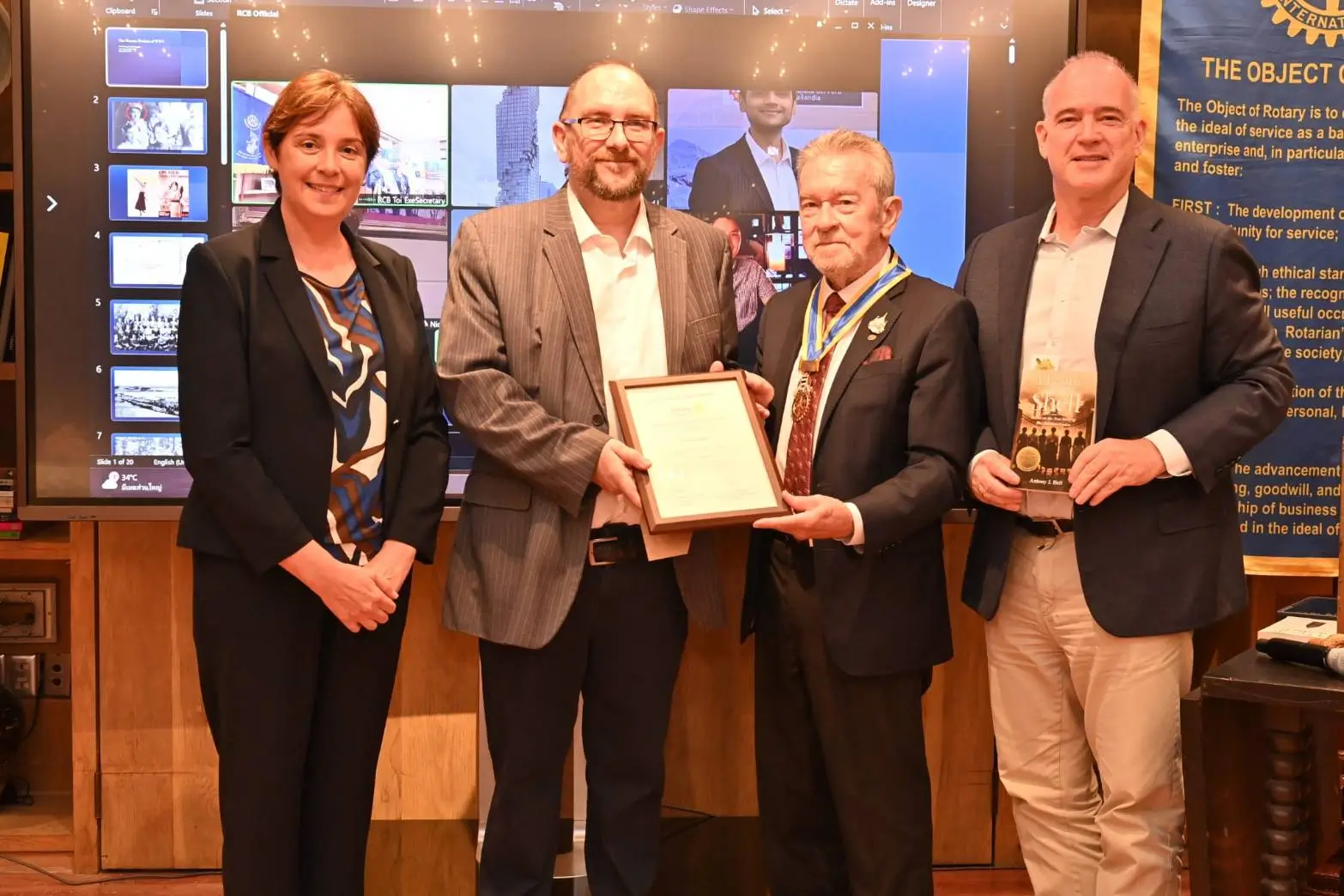
From Barnbow to Bangkok – I recently had the pleasure of speaking at the Rotary Club of Bangkok about A Penny a Shell, the Barnbow munitions factory and the real women whose experiences inspired the novel.
I’ve spoken about the book on several podcasts over the past year, but standing in front of a live audience is rather different. There is no editing, no second take and no screen between you and the people listening. You can see immediately when something surprises them, makes them laugh or, occasionally, makes the room go very quiet.
For my first proper live talk about A Penny a Shell, I couldn’t have asked for a better audience.
The Story Behind A Penny a Shell
I began with the story that started all of this for me: my great-grandmother, Sarah Ann Jennings.
For most of my life, I knew very little about Sarah Ann. My grandfather had grown up believing that his mother died at sea during the First World War, aboard a hospital ship in the North Sea.
Years later, while researching my family history, I discovered that wasn’t what happened.
Sarah Ann had worked at the Barnbow munitions factory outside Leeds. On the night of 5 December 1916, she was working in Room 42 when an explosion tore through the building. Thirty-five women and girls were killed.
Sarah Ann was one of them.
Finding her in the records answered one family mystery. It also opened the door to a much bigger story.
The Barnbow Lasses
Barnbow became one of Britain’s most important shell-filling factories during the First World War. Thousands of women worked there, producing the ammunition desperately needed by the men fighting overseas.
It was difficult, dangerous work.
These women weren’t distant historical figures. They were daughters, wives, mothers, sisters and friends. They travelled to work, worried about money, laughed together, argued, fell in love and went home exhausted at the end of a shift.
Then, on 5 December 1916, 35 of them didn’t come home.
Because of wartime censorship, the Barnbow explosion received little public attention at the time. Even today, outside Yorkshire and those with an interest in First World War history, relatively few people know what happened there.

That was one of the reasons I wanted to write A Penny a Shell.
Turning History into a Novel
The historical record can tell us an extraordinary amount, but eventually it runs out.
We have names. Addresses. Ages. Jobs. Newspaper reports. Official documents. We can reconstruct much of what happened at Barnbow and understand the enormous contribution its workforce made to Britain’s war effort.
What the records can’t give us is every conversation in a kitchen, every friendship on a factory floor or what it felt like to walk through those gates knowing the dangers waiting on the other side.
That is where historical fiction comes in.
A Penny a Shell isn’t Sarah Ann’s biography. It is a novel inspired by the world she and thousands of other Yorkshire women inhabited.
The history gave me the framework. Fiction allowed me to put people back inside it.
Telling a Yorkshire Story From Barnbow to Bangkok
There was something slightly strange, and rather wonderful, about standing in Bangkok more than a century later talking about a munitions factory outside Leeds.

Yet the distance didn’t seem to matter.
As the talk progressed, I could see people becoming interested not simply in the explosion itself, but in the women behind it and in the process of uncovering a family story that had been lost for generations.
That is one of the things I’ve discovered since publishing A Penny a Shell. The novel is rooted very firmly in Yorkshire, but the themes behind it aren’t particularly local.
Family, loss, friendship, sacrifice and the things one generation fails to tell the next travel remarkably well.
From Podcasts to a Live Audience
Until now, most of my speaking about A Penny a Shell has been through podcasts and interviews.
I’ve had the opportunity to discuss the book and its history on Mentioned in Dispatches, Battles of the First World War, Memory and Valour and Book Talk. Each has allowed me to explore a slightly different part of the story.
A live talk is different.
You can look around the room. You can change pace when you sense that something has caught people’s attention. Questions can take the conversation somewhere you hadn’t expected.
And, perhaps most importantly, you get to meet the people who have spent the previous hour listening to you talk about something that has occupied a fairly large part of your life.
My thanks to everyone at the Rotary Club of Bangkok for the invitation, the warm welcome and the opportunity to tell Sarah Ann’s story and that of the Barnbow Lasses.
Another Bangkok Talk Coming Up
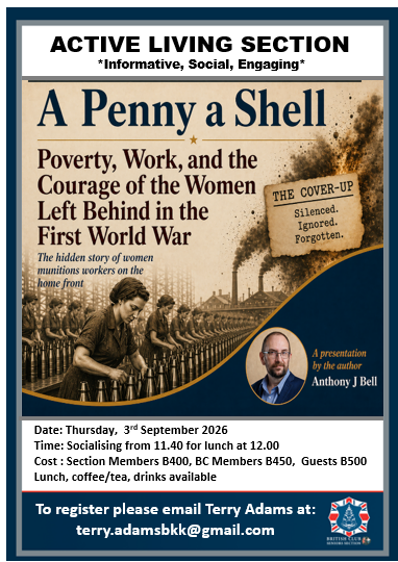
The Rotary Club won’t be my last opportunity to talk about A Penny a Shell in Bangkok.
On Thursday, 3 September 2026, I’ll be speaking at the British Club Bangkok, with a talk entitled A Penny a Shell: Poverty, Work, and the Courage of the Women Left Behind in the First World War.
I’ll be looking more closely at the lives of the women who went into Britain’s wartime factories: where they came from, the work they did, the risks they faced, and why so many of their stories were subsequently forgotten.
It will also be another chance to tell the story of Barnbow and the women whose lives ultimately inspired A Penny a Shell.
Hopefully, Yorkshire Next
Barnbow’s story began in Yorkshire, and I would love the opportunity to take this talk there.
There are still communities around Leeds where the women of Barnbow lived, families descended from the people who worked there and local history groups keeping their stories alive. Being able to speak about Sarah Ann, Barnbow and A Penny a Shell in those places would mean a great deal to me.
So Bangkok is hopefully only the beginning.
If you represent a history society, library, book club, school, festival or other organisation interested in a talk about Barnbow, the women of Britain’s First World War munitions factories, or the history behind A Penny a Shell, please feel free to get in touch.
Discover A Penny a Shell — a historical novel based on the true story of the Barnbow Lasses.